
ZKD ISO 639-3
Kadu
Asak Autonym
A language of Myanmar
- ISO 639
- zkd
- Alternate Names
- Gadu, Ka’do, Kadu-Ganaan, Kantu’, Kato, Kudo, Maw, Mawteik, Puteik, Thet
- Autonym
- Asak
- Population
- 30,000 (2007 SIL), decreasing. Over 30 villages in Mawteik dialect (nearly extinct); over 30 villages in Settaw dialect; 5 villages in Mawkhwin dialect. No monolinguals.
- Location:
- Sagaing region: Katha district, Banmauk and Indaw townships; Homalin, Paungbyin, Pinlebu, and Wuntho townships.
- Language Status
- 6b (Threatened).
- Classification
- Sino-Tibetan, Tibeto-Burman, Sal, Jingppaw-Asakia, Asakian
- Dialects
- Mawkhwin, Settaw, Mawteik. Each Kadu dialect distinct with low comprehension between the Mawkhwin, Settaw, and Mawteik Kadu varieties. All Kadu (except possibly Mawkhwin Kadu) have low comprehension of Kanan [zkn]. Lexical similarity: 95%–98% with Settaw and Mawteik Kadu, 91%–93% with Mawkhwin Kadu and other Kadu varieties, 84%–89% with Kadu varieties and Kanan [zkn].
- Language Use
- Vigorous in Banmauk Township (Settaw and Mawkhwin dialects), almost extinct in Indaw and Pinlebu townships (Mawteik dialect) where speakers have shifted to Burmese [mya]. All domains. Some young people, all adults. All ages in Banmauk Township; only over 80 years old in Indaw Township. Positive attitudes. Also use Burmese [mya].
- Language Development
- Grammar. Bible portions: 1939.
- Language Resources
- OLAC resources in and about Kadu
- Writing
- Latin script [Latn], in development.
- Other Comments
- Different from Kaduo [ktp], a Sino-Tibetan language of China and Laos. The Kadu say they are descended from the Thet, also known as Sak (see Chak [ckh]). Buddhist.
Also Spoken in
Map
Location: Sagaing region: Katha district, Banmauk and Indaw townships; Homalin, Paungbyin, Pinlebu, and Wuntho townships.
Size and Vitality
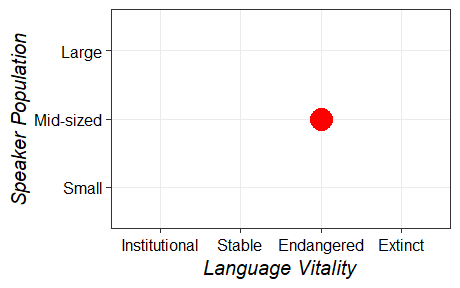 Click to enlarge with explanation
Place in Language Cloud
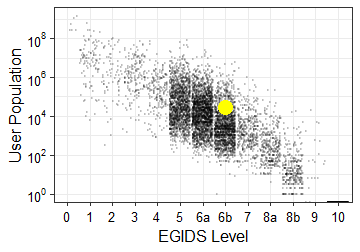 Click to enlarge with explanation