
XAL ISO 639-3
Kalmyk-Oirat
хальмг келн (Xaľmg keln) Autonym
A language of Russian Federation
- ISO 639
- xal
- Alternate Names
- European Oirat, Kalmack, Kalmuck, Kalmuk, Kalmytskii Jazyk, Khalli, Oirat, Qalmaq, Volga Oirat, Western Mongolian
- Autonym
- хальмг келн (Xaľmg keln)
- Population
- 80,500 in Russian Federation (2010 census). Ethnic population: 183,000 (2010 census). Total users in all countries: 431,800.
- Location:
- Kalmykia republic; Astrakhan province; and Stavropol krai; Volga-Don steppes northwest of the Caspian, north of the Caucasus. West Kalmykia republic (Dörböt dialect); east, lower Volga region, Astrakhan province (Torgut dialect).
- Language Status
- 2 (Provincial). Statutory provincial language in Republic of Kalmykia (1999, Law on the Languages of the Republic of Kalmykia, Article 3), Co-official with Russian.
- Classification
- Mongolic, Eastern, Oirat-Khalkha, Oirat-Kalmyk-Darkhat
- Dialects
- Buzawa, Oirat (Oyrat), Torgut (Torghoud, Torghud, Torguud, Torguut), Dörböt (Derbet, Dörbet, Dörböd). Diverged from other Mongolian languages. Called Kalmyk in the Russian Federation; Oirat in China and Mongolia; in the United States, Kalmyk not heavily influenced by Russian [rus]. Different from other varieties in China called Oirat [xal], which are sometimes called Asiatic Oirat. In Mongolia, some scholars consider Oirat to be a dialect of Halh Mongolian [khk].
- Language Use
- 91% speak it as L1. Some young people, all adults. A few children learn the language. Also use Central Tibetan [bod], in religious domains. Also use Russian [rus].
- Language Development
- Dictionary. Grammar. NT: 1827–2009.
- Language Resources
- OLAC resources in and about Kalmyk-Oirat
- Writing
- Cyrillic script [Cyrl], adopted in 1924, used in Russia and Mongolia. Mongolian script [Mong], Todo style, used in China.
- Other Comments
- The modern literary language is mainly based on the Torgut dialect, though it incorporates a large number of concessions to Dörböt. Buddhist.
Also Spoken in
- Location
- Gansu province: northern border area; Nei Mongol Autonomous Region: Alashan league; Qinghai province: Kukunor region, Lake Qinghai northwest; Xinjiang Uyghur Autonomous Region: Jungaria region.
- Dialects
- Torgut (Torghut, Tu’erhute), Kök Nur (Qinghai), Jakhachin, Bayit, Mingat, Olot (Eleuth, Elyut, Ööld), Khoshut (Khoshuud), Dorbot, Henan.
- Language Status
- 7 (Shifting)
- Other Comments
- Non-indigenous. View other languages of China
Language Name
Kalmyk-Oirat
User Population
130,000 in China (Salminen 2007).
- Location
- Ysyk-Kol region.
- Dialects
- Oirat (Sart Qalmaq).
- Language Status
- 8a (Moribund)
- Other Comments
- Non-indigenous. View other languages of Kyrgyzstan
Language Name
Kalmyk-Oirat
User Population
300 in Kyrgyzstan (2009 census). Ethnic population: 4,200 (2009 census).
- Location
- Arhangay, and Bayan-Olgiy, Dzavhan, Hovd, Hovsgol, Govi-Altay, and Uvs provinces.
- Dialects
- Zakhchin (Jakhachin), Bayit (Bayad), Myangad (Mingat), Olot (Eleuth, Elyut, Uuld, Ööld), Khoshut (Khoshuud), Uriankhai, Khoton (Hoton), Durbet (Durvud), Torguud.
- Language Status
- 6b (Threatened)
- Other Comments
- Non-indigenous. Khoton (Hoton) originally of Turkic origin (Kara 1990), and were Muslim. Different from Chinese-speaking Qotong (Hoton) [cmn]. View other languages of Mongolia
Language Name
Oirat
User Population
221,000 in Mongolia (2016). 53,400 Bayit, 74,600 Durbet, 12,200 Khoton, 6,300 Myangad, 13,400 Olot, 15,000 Torguud, 26,100 Uriankhai, and 31,600 Zakhchin (2016, based on 2015 census).
Map
Location: Kalmykia republic; Astrakhan province; and Stavropol krai; Volga-Don steppes northwest of the Caspian, north of the Caucasus. West Kalmykia republic (Dörböt dialect); east, lower Volga region, Astrakhan province (Torgut dialect).
Size and Vitality
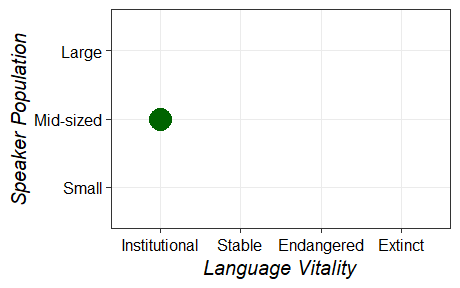 Click to enlarge with explanation
Place in Language Cloud
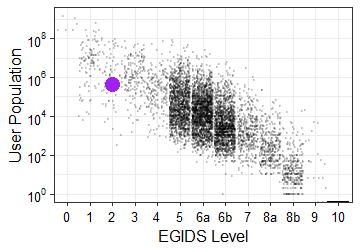 Click to enlarge with explanation