
WUH ISO 639-3
Wutunhua
A language of China
- ISO 639
- wuh
- Alternate Names
- Ngandehua, Sanggaixiong, Wutong, Wutun
- Population
- 4,000 (2016 E. Sandman).
- Location:
- Qinghai province: Huangnan Tibetan autonomous prefecture, Tongren county, Longwu township, Jiangchama and Upper and Lower Wutun villages.
- Language Status
- 6a (Vigorous). Language of recognized nationality: Tu.
- Classification
- Mixed language, Chinese-Tibetan-Bonan Mongour
- Typology
- SOV; adjectives follow nouns; adverbials precede predicate; case and number marked on nouns; agglutinative language; prenasalized consonants; 38 consonants and 6 vowels; non-tonal; most words polysyllabic; 60% Chinese, 20% Tibetan vocabulary with the rest having mixed Chinese and Tibetan elements.
- Language Use
- Used by all. Positive attitudes. Most also use Amdo Tibetan [adx] (Sandman 2016). Many also use Mandarin Chinese [cmn], especially among young people (Sandman 2016).
- Language Development
- Grammar.
- Other Comments
- A variety of Chinese heavily influenced by Tibetan or perhaps a Tibetan language undergoing relexification with Chinese forms. Also described as Chinese which converged to an agglutinative language, Tibetan or Mongolian, using only Chinese material. Known for their paintings of Buddha. Buddhist.
Also Spoken in
Map
Location: Qinghai province: Huangnan Tibetan autonomous prefecture, Tongren county, Longwu township, Jiangchama and Upper and Lower Wutun villages.
Size and Vitality
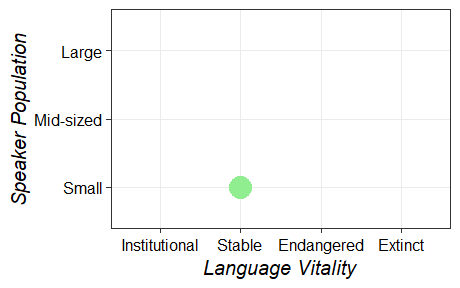 Click to enlarge with explanation
Place in Language Cloud
 Click to enlarge with explanation