
WLO ISO 639-3
Wolio
A language of Indonesia
- ISO 639
- wlo
- Alternate Names
- Baubau, Buton, Butonese, Butung
- Population
- 65,000 in Indonesia (2004 D. Andersen). Population does not include those in other provinces.
- Location:
- Southeast Sulawesi province: Buton regency, Bau-Bau city on Buton island southwest coast.
- Language Status
- 6b (Threatened).
- Classification
- Austronesian, Malayo-Polynesian, Celebic, Wotu-Wolio, Wolio-Kamaru
- Dialects
- Lexical similarity: 61% with Cia-Cia [cia]; 60% with Masiri dialect of Cia-Cia and Lantoi dialect of Kaimbulawa [zka].
- Typology
- 29 consonants and 5 vowels.
- Language Use
- Former court language of Baubau Sultanate, and surrounding communities; formerly used by nobility in the region. Wolio is declining in the urban center, but being maintained at the rural periphery. Some young people, all adults. Children in villages use Wolio, but city children primarily use Indonesian. Most also use Indonesian [ind]. Some also use Muna [mnb]. Some also use Pancana [pnp]. Used as L2 by Busoa [bup], Cia-Cia [cia], Kamaru [kgx], Kioko [ues], Liabuku [lix], Muna [mnb], Pancana [pnp], Taloki [tlk].
- Language Development
- Dictionary. Texts.
- Language Resources
- OLAC resources in and about Wolio
- Writing
- Arabic script, Naskh variant [Arab], no longer in use.
- Other Comments
- ‘Buton’ usually used generically inside Southeast Sulawesi to refer to Wolio; outside Southeast Sulawesi it refers to people from Southeast Sulawesi, or is sometimes confused with Bajau people as sailors. Muslim.
Also Spoken in
Map
Location: Southeast Sulawesi province: Buton regency, Bau-Bau city on Buton island southwest coast.
Size and Vitality
 Click to enlarge with explanation
Place in Language Cloud
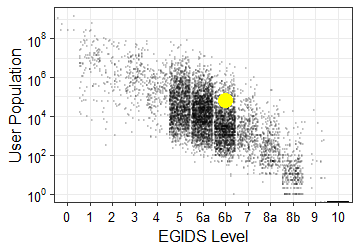 Click to enlarge with explanation