
WES ISO 639-3
Pidgin, Cameroon
Pidgin Autonym
A language of Cameroon
- ISO 639
- wes
- Alternate Names
- CPE, Cameroon Creole, Cameroon Creole English, Cameroonian Creole, Kamtok, Wes Cos, “Bush English” (pej.)
- Autonym
- Pidgin
- Population
- 12,000,000 (Ayafor and Green 2017), all users.
- Location:
- Primarily South West and North West regions; Centre and Littoral regions; Douala, Yaoundé, and other urban centers.
- Language Status
- 3 (Wider communication). Originated along the West Coast of Africa from Sierra Leone through Nigeria to Cameroon around 1800 and was used as a trade language between 1800 and 1884. Later used in market, prisons, playground, school campuses, and political campaigns. Now the most widespread lingua franca in Cameroon, used by about half the population (Todd and Mühlhäusler 1978). Also used in spoken media.
- Classification
- Creole, English based, Atlantic, Krio
- Dialects
- Reportedly similar to Krio [kri] of Sierra Leone and Pidgin English of various West African countries; probably an offshoot of 19th century Krio. Also similar to Sranan Tongo [srn] (Todd and Mühlhäusler 1978). Dialect variations.
- Language Use
- Growing number of L1 speakers. Most also use English [eng], especially since English is the language of education and government in the entire anglophone region, where Cameroon Pidgin is widely used. Used as L2 by Adamawa Fulfulde [fub], Aghem [agq], Ajumbu [muc], Akoose [bss], Akum [aku], Babanki [bbk], Bafanji [bfj], Bafut [bfd], Balo [bqo], Bamali [bbq], Bambalang [bmo], Bambili-Bambui [baw], Bamenyam [bce], Bamukumbit [bqt], Bamun [bax], Bamunka [bvm], Bangolan [bgj], Bankon [abb], Barombi [bbi], Basaa [bas], Beezen [bnz], Bubia [bbx], Bulu [bum], Bum [bmv], Caka [ckx], Chungmboko [cug], Denya [anv], Duala [dua], Ejagham [etu], Eman [emn], Esimbi [ags], Evant [bzz], Fang [fak], Fe’fe’ [fmp], Ghomálá’ [bbj], Iceve-Maci [bec], Ipulo [ass], Isu [isu], Isu [szv], Iyive [uiv], Kemedzung [dmo], Kendem [kvm], Kenswei Nsei [ndb], Kenyang [ken], Kom [bkm], Koshin [kid], Kung [kfl], Kutep [kub], Lamnso’ [lns], Limbum [lmp], Mbessa [emz], Mbo [mbo], Mbororo Fulfulde [fuv], Medumba [byv], Mengaka [xmg], Mesaka [iyo], Meta’ [mgo], Mokpwe [bri], Mubako [muo], Mundabli [boe], Mungaka [mhk], Mungbam [mij], Naami [bzv], Naki [mff], Nchane [ncr], Ngamambo [nbv], Ngemba [nge], Ngiemboon [nnh], Ngomba [jgo], Ngombale [nla], Ngwe [nwe], Njen [njj], Noone [nhu], Northwest Gbaya [gya], Oku [oku], Oroko [bdu], Osatu [ost], Pere [pfe], Pinyin [pny], Sari [asj], Supapya [bbw], Tigon Mbembe [nza], Tuotomb [ttf], Vengo [bav], Weh [weh], Wushi [bse], Yamba [yam], Yemba [ybb], Yukuben [ybl].
- Language Development
- Very negative attitudes towards its possible use in schools. Dictionary. Grammar. NT: 2002.
- Language Resources
- OLAC resources in and about Pidgin, Cameroon
- Writing
- Latin script [Latn].
- Other Comments
- Christian, Muslim, traditional religion.
Also Spoken in
Map
Location: Primarily South West and North West regions; Centre and Littoral regions; Douala, Yaoundé, and other urban centers.
Size and Vitality
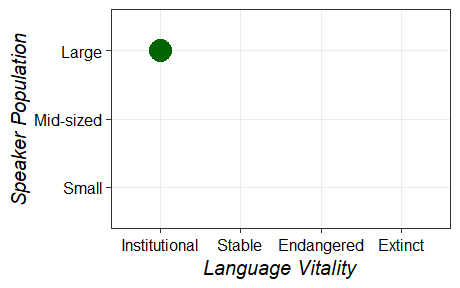 Click to enlarge with explanation
Place in Language Cloud
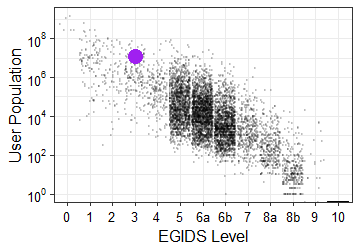 Click to enlarge with explanation