
UZN ISO 639-3
Uzbek, Northern
oʻzbek tili, ўзбек тили (oʻzbek tili) Autonym
A language of Uzbekistan
- ISO 639
- uzn
- Alternate Names
- oʻzbek, oʻzbekcha, Özbek
- Autonym
- oʻzbek tili, ўзбек тили (oʻzbek tili)
- Population
- 24,500,000 in Uzbekistan (2019 World Factbook). Ethnic population: 27,600,000 (2019 World Factbook). Total users in all countries: 27,745,270.
- Location:
- Widespread.
- Language Status
- 1 (National). Statutory national language (1995, Official Language Law (amended), 3561-XI, Article 1).
- Classification
- Turkic, Eastern
- Dialects
- Karluk (Qarlug), Kipchak (Kypchak), Oghuz. Distinct from Southern Uzbek [uzs] of Afghanistan, Pakistan, and Turkey. Russian [rus] influences in grammar, use of loanwords, and script. Oghuz may be a dialect of Khorasani Turkish [kmz] in Turkey rather than Uzbek. A member of macrolanguage Uzbek [uzb].
- Typology
- SOV; postpositions; noun head final; no articles; case-marking (5 cases); verb affixes mark person, number; passives; tense; comparatives; 24 consonant and 8 vowel phonemes; non-tonal; stress on final syllable; has lost its historical vowel harmony and its vowel system now resembles that of Tajiki.
- Language Use
- Vigorous. Turks of Fergana and Samarkand speak Uzbek. Uzbek-speaking Roma communities in Russian central Asia. Used by all. Positive attitudes. Also use Russian [rus].
- Language Development
- Literacy rate in L2: High. Taught in primary and secondary schools. Radio. TV. Dictionary. Grammar. Bible: 2016.
- Language Resources
- OLAC resources in and about Uzbek, Northern
- Writing
- Arabic script, Naskh variant [Arab], symbolic use in Uzbekistan, sometimes used in China. Braille script [Brai]. Cyrillic script [Cyrl], official usage between 1940-1992 in Uzbekistan, continued widespread use in Uzbekistan and China. Latin script [Latn], official usage since 1992 in Uzbekistan.
- Other Comments
- About a third urbanized. Much Persian influence in language and culture. Patrilineal. Sart is a pejorative name which had been used by the occupying Russians and by the Kazakhs (Allworth 1990). Muslim.
Also Spoken in
- Location
- North and west Xinjiang Uyghur Autonomous Region; Urumqi, Kashgar, and Yining (Ghulja) cities, especially Ili.
- Dialects
- Andizhan, Tashkent, Samarkand, Fergana.
- Language Status
- 5 (Dispersed)
- Other Comments
- Non-indigenous. Muslim. View other languages of China
Language Name
Uzbek, Northern
User Population
5,000 in China (2000 Chen Shiliang). Ethnic population: 10,600 (2010 census).
- Language Status
- Unestablished
- Other Comments
- Non-indigenous. View other languages of Germany
Language Name
Uzbek, Northern
User Population
9,330 in Germany (2020 census). , based on nationality.
- Location
- Scattered, mostly south.
- Language Status
- 5 (Dispersed)
- Other Comments
- Non-indigenous. View other languages of Kyrgyzstan
Language Name
Uzbek, Northern
User Population
910,000 in Kyrgyzstan (2018). Ethnic population: 768,000 (2009 census).
- Location
- Jambyl and South Kazakhstan regions.
- Language Status
- 5 (Dispersed)
- Other Comments
- Non-indigenous. View other languages of Kazakhstan
Language Name
Uzbek, Northern
User Population
436,000 in Kazakhstan (2009 census). Ethnic population: 457,000 (2009 census).
- Language Status
- Unestablished
- Other Comments
- Non-indigenous. View other languages of Russian Federation
Language Name
Uzbek, Northern
User Population
273,500 in Russian Federation (2010 census).
- Language Status
- Unestablished
- Other Comments
- Non-indigenous. View other languages of Sweden
Language Name
Uzbek, Northern
User Population
3,120 in Sweden (2020 census). , based on nationality.
- Location
- Khatlon and Sughd regions; Regions of Republican Subordination.
- Language Status
- 5 (Dispersed) View other languages of Tajikistan
Language Name
Uzbek, Northern
User Population
1,060,000 in Tajikistan (2017). Ethnic population: 1,230,000 (2017).
- Location
- Dasoguz province: Dashhowuz area; scattered elsewhere.
- Language Status
- 5 (Dispersed) View other languages of Turkmenistan
Language Name
Uzbek, Northern
User Population
543,000 in Turkmenistan (2020). Ethnic population: 302,000 (2020).
- Language Status
- Unestablished
- Other Comments
- Non-indigenous. View other languages of Ukraine
Language Name
Uzbek, Northern
User Population
3,600 in Ukraine (2001 census). Ethnic population: 12,400 (2001 census).
Map
Location: Widespread.
Size and Vitality
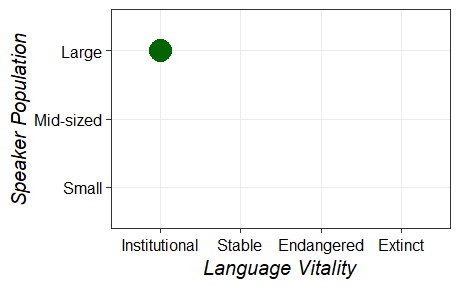 Click to enlarge with explanation
Place in Language Cloud
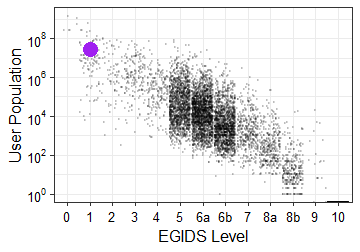 Click to enlarge with explanation