
UDI ISO 639-3
Udi
udin muz Autonym
A language of Azerbaijan
- ISO 639
- udi
- Alternate Names
- Udin, Uti
- Autonym
- udin muz
- Population
- 3,800 in Azerbaijan (2011 UNSD). Ethnic population: 7,000 (1990 DOBES). Total users in all countries: 6,160.
- Location:
- Oguz and Qabala districts: Mirzabeyli, Niç, and Oghuz.
- Language Status
- 6b (Threatened). De facto language of provincial identity in Qabala District.
- Classification
- Nakh-Daghestanian, Lezgic, Udi
- Dialects
- Oghuz (Vartashen), Nidzh (Nic, Nij, Nizh). Oktomberi dialect more divergent from Nic Udi than from Oghuz Udi. One of the most divergent Lezgian (Lezgic) languages.
- Language Use
- Young people use a strongly Azeri-influenced variety of Udi, which could be described as‘Young People’s Udi’ (2018 DOBES). Home, community. Some young people, all adults. Used by 30%–50% of children. Neutral attitudes. Udi not seen as prestigious as Russian [rus]. Most also use North Azerbaijani [azj]. Some also use Judeo-Tat [jdt]. Also use Armenian [hye]. Also use Russian [rus].
- Language Development
- Discussing how their language can be saved. Taught in primary schools, through fourth grade. Literature. Dictionary. Bible portions: 1902–2018.
- Language Resources
- OLAC resources in and about Udi
- Writing
- Cyrillic script [Cyrl]. Latin script [Latn].
- Other Comments
- Nic dialect is vigorous (6a). Oghuz dialect is moribund (8a), as only about 100 persons remain in Oghuz. Christian.
Also Spoken in
- Location
- Kakheti region: Oktomberi village.
- Dialects
- Oktomberi.
- Language Status
- 7 (Shifting)
- Other Comments
- Non-indigenous. View other languages of Georgia
Language Name
Udi
User Population
90 in Georgia (Leclerc 2015). Ethnic population: 500 (1990 A. Kibrik).
- Language Status
- Unestablished
- Other Comments
- Non-indigenous. View other languages of Russian Federation
Language Name
Udi
User Population
2,270 in Russian Federation (2010 census). Ethnic population: 4,270 (2010 census).
Map
Location: Oguz and Qabala districts: Mirzabeyli, Niç, and Oghuz.
Size and Vitality
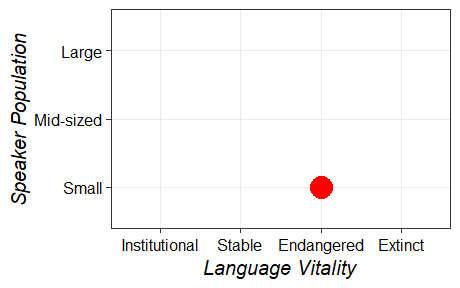 Click to enlarge with explanation
Place in Language Cloud
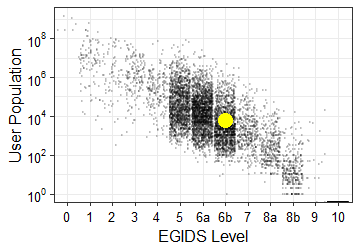 Click to enlarge with explanation