
TUK ISO 639-3
Turkmen
Türkmençe, түркменче (Türkmençe) Autonym
A language of Turkmenistan
- ISO 639
- tuk
- Alternate Names
- Trukhmen, Trukhmeny, Turkmani, Turkmanian, Turkmenian, Turkmenler, Turkomans, Türkmen dili
- Autonym
- Türkmençe, түркменче (Türkmençe)
- Population
- 4,340,000 in Turkmenistan (2020 World Factbook). Ethnic population: 5,100,000 (2020). Total users in all countries: 7,623,060.
- Location:
- Widespread.
- Language Status
- 1 (National). Statutory national language (1992, Constitution, Article 13).
- Classification
- Turkic, Southern, Turkmenian
- Dialects
- Nokhurli, Anauli, Khasarli, Nerezim, Yomud, Teke (Tekke), Goklen, Salyr, Saryq, Esari, Cawdur.
- Typology
- SOV; postpositions; no articles; case-marking (5 cases); verb affixes mark person, number; passives; tense; 23 consonant and 9 vowel phonemes; non-tonal; vowel harmony; evidentials.
- Language Use
- Also use Russian [rus].
- Language Development
- Literature. Periodicals. Radio. TV. Dictionary. Grammar. Texts. Bible: 2017.
- Language Resources
- OLAC resources in and about Turkmen
- Writing
- Arabic script, Naskh variant [Arab], used in Afghanistan and Iran. Cyrillic script [Cyrl], used in Turkmenistan, not used in Afghanistan. Latin script [Latn], official usage in Turkmenistan since 1991.
- Other Comments
- Turkmen in Syria and Iraq displays heavy Turkish [tur] and Arabic influences lexically with some Azeri features. Turkmen in Iran shows many Persian [pes] features. Muslim.
Also Spoken in
- Location
- Badghis, Balkh, Faryab, Herat, Jawzjan, and Kunduz provinces; most live outside cities, including Kabul; northern border of Uzbekistan, Tajikistan.
- Dialects
- Ärsare (Arsariy), Shirik, Teke (Taka), Yomut, Bayat, Xatap.
- Language Status
- 5 (Dispersed)
- Other Comments
- Most Turkmen in Afghanistan use Ärsare. Muslim. View other languages of Afghanistan
Language Name
Turkmen
User Population
1,700,000 in Afghanistan (2017 J. Leclerc).
- Language Status
- Unestablished
- Other Comments
- Non-indigenous. View other languages of Germany
Language Name
Turkmen
User Population
1,940 in Germany (2020 census). , based on nationality.
- Location
- Scattered.
- Language Status
- 5 (Dispersed)
- Other Comments
- Non-indigenous. Turkmen in Iraq displays heavy Turkish [tur] and Arabic influences lexically with some Azeri features. View other languages of Iraq
Language Name
Turkmen
User Population
470,000 in Iraq (2020).
- Location
- Golestan, Razavi Khorasan, and North Khorasan provinces: Turkmenistan border area; Mazandaran province: Gonbad-e Kavus and Pahlavi Dezh.
- Dialects
- Anauli, Khasarli, Nerezim, Nokhurli (Nohur), Chavdur, Esari (Esary), Goklen (Goklan), Salyr, Saryq, Teke (Tekke), Yomud (Yomut), Trukmen.
- Language Status
- 5 (Dispersed)
- Other Comments
- Not a literary language in Iran. Many are seminomadic. Ethnic groups: Yomut, Goklan. Turkmen in Iran shows many Persian [pes] features. Muslim. View other languages of Iran
Language Name
Turkmen
User Population
746,000 in Iran (2019). Ethnic population: 2,570,000 (2019).
- Language Status
- Unestablished
- Other Comments
- Non-indigenous. View other languages of Kyrgyzstan
Language Name
Turkmen
User Population
1,200 in Kyrgyzstan (2009 census). Ethnic population: 1,400 (2009 census).
- Language Status
- Unestablished
- Other Comments
- Non-indigenous. View other languages of Kazakhstan
Language Name
Turkmen
User Population
1,800 in Kazakhstan (Leclerc 2017e).
- Location
- Several refugee camps near Quetta, and in cities.
- Language Status
- Unestablished
- Other Comments
- Non-indigenous. Muslim. View other languages of Pakistan
Language Name
Turkmen
User Population
10,900 in Pakistan (2016).
- Location
- Astrakhan province; Stavropol krai.
- Language Status
- 5 (Dispersed)
- Other Comments
- Non-indigenous. View other languages of Russian Federation
Language Name
Turkmen
User Population
30,800 in Russian Federation (2010 census). Ethnic population: 36,900 (2010 census).
- Location
- Scattered.
- Language Status
- 5 (Dispersed)
- Other Comments
- Non-indigenous. Turkmen in Syria displays heavy Turkish [tur] and Arabic influences lexically with some Azeri features. View other languages of Syria
Language Name
Turkmen
User Population
109,000 in Syria (2019).
- Location
- Khatlon region: scattered.
- Language Status
- Unestablished
- Other Comments
- Non-indigenous. View other languages of Tajikistan
Language Name
Turkmen
User Population
13,700 in Tajikistan (2012 UNSD). Ethnic population: 32,500 (2017).
- Location
- Tokat province.
- Language Status
- 5 (Dispersed)
- Other Comments
- Non-indigenous. Refugees from Afghanistan; now Turkish citizens. Muslim. View other languages of Turkey
Language Name
Turkmen
- Location
- Scattered along Turkmenistan border.
- Language Status
- Unestablished
- Other Comments
- Non-indigenous. View other languages of Uzbekistan
Language Name
Turkmen
User Population
197,000 in Uzbekistan (2019).
Map
Location: Widespread.
Size and Vitality
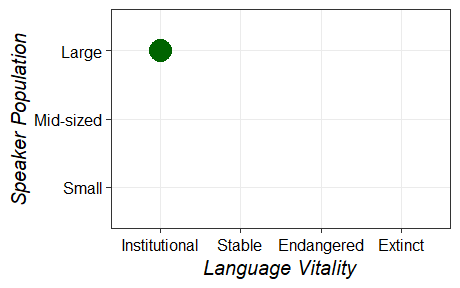 Click to enlarge with explanation
Place in Language Cloud
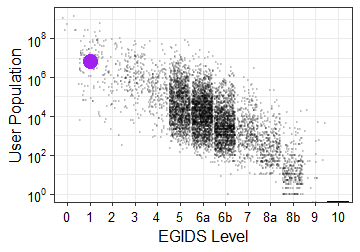 Click to enlarge with explanation