
TEO ISO 639-3
Ateso
Atεsᴐ Autonym
A language of Uganda
- ISO 639
- teo
- Alternate Names
- Bakedi, Bakidi, Elgumi, Etossio, Ikumama, Iteso, Teso, Wamia
- Autonym
- Atεsᴐ
- Population
- 2,360,000 in Uganda (2014 census), increasing. Census based on tribal affiliation. Total users in all countries: 2,778,000.
- Location:
- Amuria, Bukedea, Butebo, Kaberamaido, Katakwi, Kumi, Ngora, Pallisa, Serere, Soroti, and Tororo districts; Lake Bisina area.
- Language Status
- 4 (Educational). De facto language of provincial identity in Tororo, 10 other districts.
- Classification
- Nilo-Saharan, Satellite-Core, Core, Eastern Sudanic, Southern (n languages), Nilotic, Eastern, Lotuxo-Teso, Teso-Turkana, Teso
- Dialects
- Orom (Rom). Limited intelligibility with other varieties in the Teso-Turkana group. The dialect in Ngora is considered standard. Lexical similarity: 76% with Turkana [tuv], 75% with Ng’aKarimojong [kdj].
- Typology
- VSO; highly inflectional; grammatical tone; vowel harmony.
- Language Use
- Vigorous. Home, market, work. Used by all. Positive attitudes. Most also use English [eng]. Some also use Swahili [swh]. Used as L2 by Kenye [lke], Kumam [kdi].
- Language Development
- Taught in primary schools. Taught in secondary schools, as a subject. Newspapers. Radio. Videos. Dictionary. Texts. Bible: 1961.
- Language Resources
- OLAC resources in and about Ateso
- Writing
- Latin script [Latn], used since 1930.
- Other Comments
- Christian.
Also Spoken in
- Location
- Busia county: north of Mambara.
- Dialects
- Orom (Rom).
- Language Status
- 6a (Vigorous)
- Other Comments
- Christian, traditional religion. View other languages of Kenya
Language Name
Ateso
User Population
418,000 in Kenya (2019 census), increasing. , based on ethnicity.
Map
Location: Amuria, Bukedea, Butebo, Kaberamaido, Katakwi, Kumi, Ngora, Pallisa, Serere, Soroti, and Tororo districts; Lake Bisina area.
Size and Vitality
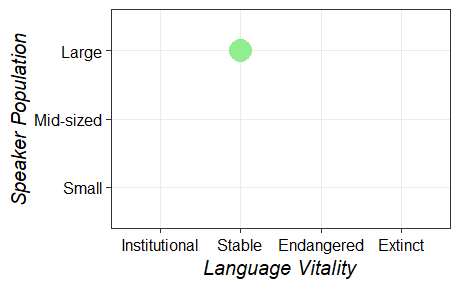 Click to enlarge with explanation
Place in Language Cloud
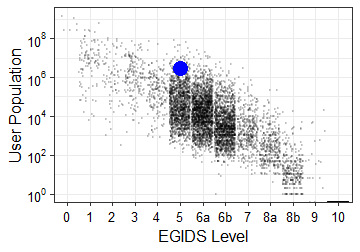 Click to enlarge with explanation