
SNA ISO 639-3
Shona
Chishona Autonym
A language of Zimbabwe
- ISO 639
- sna
- Alternate Names
- chiShona, “Swina” (pej.)
- Autonym
- Chishona
- Population
- 10,660,000 in Zimbabwe, all users. L1 users: 7,160,000 in Zimbabwe (2012). L2 users: 3,500,000 (2019). Total users in all countries: 10,865,590 (as L1: 7,365,590; as L2: 3,500,000).
- Location:
- Harare, Mashonaland Central, Mashonaland East, Mashonaland West, and Midlands provinces. Manicaland province, Nyanga district (Hwesa dialect); Mashonaland East, Mudzi and Mutoko districts (Budja dialect).
- Language Status
- 3 (Wider communication). Recognized language (2013, Constitution, Article 6(1)).
- Classification
- Niger-Congo, Atlantic-Congo, Volta-Congo, Benue-Congo, Bantoid, Southern, Narrow Bantu, Central, S, Shona (S.10)
- Dialects
- Karanga (Chikaranga), Zezuru (Bazezuru, Bazuzura, Chizezuru, Harava, Hera, Mazizuru, Shawasha, Vazezuru, Wazezuru), Korekore (Goba, Gova, Northern Shona, Shangwe), Hwesa (Chihwesa), Budja. Subdialects: Karanga: Duma, Jena, Mhari (Mari), Ngova, Nyubi, Govera; Korekore: Budya, Gova, Tande, Tavara, Nyongwe, Pfunde, Shan Gwe; Zezuru: Shawasha, Gova, Mbire, Tsunga, Kachikwakwa, Harava, Nohwe, Njanja, Nobvu, Kwazwimba (Zimba); Shona: Toko, Hwesa. Rozvi (Rozwi, Ruzwi, Chirozwi) speak Karanga dialect. Ndau [ndc] and Manyika [mxc] are partially intelligible of Shona.
- Typology
- SVO; noun head initial; 13 noun classes; no articles; verb affixes mark person, number, object; passives; causatives; 31 consonants, 5 vowels, 2 diphthongs; tonal (2 tones: high, low).
- Language Use
- Dominant African language understood by a considerable number. Primarily a written language apparently based on Karanga and Zezuru with lexical items also from Manyika and Korekore. Urban populations tend to speak school or standard Shona. Also use English [eng]. Used as L2 by Chichewa [nya], Kalanga [kck], Kunda [kdn], Nambya [nmq], Nsenga [nse], Tonga [toi], Zimbabwe Sign Language [zib].
- Language Development
- Literacy rate in L2: 86% in English [eng] and Shona [sna]. Taught in primary schools. Dictionary. Grammar. Bible: 1949–1980.
- Language Resources
- OLAC resources in and about Shona
- Writing
- Braille script [Brai]. Latin script [Latn], primary usage.
- Other Comments
- Traditional religion, Christian.
Also Spoken in
- Language Status
- Unestablished
- Other Comments
- Non-indigenous. View other languages of Australia
Language Name
Shona
User Population
11,000 in Australia (2016 census).
- Location
- Central district: north; North West district: northeast.
- Dialects
- Karanga.
- Language Status
- 5 (Dispersed)
- Other Comments
- Non-indigenous. View other languages of Botswana
Language Name
Zezuru
User Population
46,300 in Botswana (2020).
- Language Status
- Unestablished
- Other Comments
- Non-indigenous. View other languages of Canada
Language Name
Shona
User Population
3,190 in Canada (2016 census).
- Language Status
- Unestablished
- Other Comments
- Non-indigenous. View other languages of United Kingdom
Language Name
Shona
User Population
21,400 in United Kingdom (2011 census).
- Language Status
- Unestablished
- Other Comments
- Non-indigenous. Migrant laborers. View other languages of Malawi
Language Name
Shona
User Population
93,000 in Malawi (2021 Joshua Project). , based on ethnicity.
- Language Status
- Unestablished
- Other Comments
- Non-indigenous. View other languages of South Africa
Language Name
Shona
User Population
18,000 in South Africa (2012 J. Leclerc).
- Location
- Lusaka province: southeast of the capital; Southern province: Slavonga district; possibly Central province: near Zimbabwe border.
- Dialects
- Korekore (Budya, Goba, Gova, Gowa, Korikori, Makorekore, Northern Shona, Wakorikori).
- Language Status
- 6b (Threatened)
- Other Comments
- Korekore is the main dialect in Zambia, with subdialect Goba. View other languages of Zambia
Language Name
Shona
User Population
12,700 in Zambia (2010 census). Ethnic population: 21,900 (2010 census).
Map
Location: Harare, Mashonaland Central, Mashonaland East, Mashonaland West, and Midlands provinces. Manicaland province, Nyanga district (Hwesa dialect); Mashonaland East, Mudzi and Mutoko districts (Budja dialect).
Size and Vitality
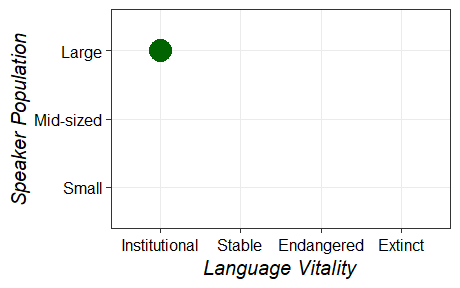 Click to enlarge with explanation
Place in Language Cloud
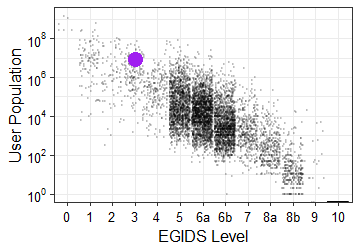 Click to enlarge with explanation