
SLR ISO 639-3
Salar
A language of China
- ISO 639
- slr
- Alternate Names
- Sala
- Population
- 70,000 (2002), increasing. Less than 10,000 monolinguals. Ethnic population: 131,000 (2010 census).
- Location:
- Gansu province: Jishishan autonomous county; Qinghai province: Hualong Hui and Xunhua Salar autonomous counties; Xinjiang Uyghur Autonomous Region, Yili, Kazakh autonomous prefecture.
- Language Status
- 6b (Threatened). Language of recognized nationality: Salar.
- Classification
- Turkic, Southern
- Dialects
- Eastern Salar (Gaizi, Gandu, Jishishan, Mengda), Western Salar (Ili). Salar is spoken by descendants of Oghuz Turks from the Samarkand region. Has an Oghuz (SW) Turkic base, and took on Eastern and Southern Siberian Turkic features through Central Asian contacts, and finally acquired a stratum of features from Chinese and Tibetan (Dwyer 1998). Gaizi (Jiezi) often seen as standard variety.
- Typology
- SOV; postpositional; verbs take up to 3 or 4 suffixes, no prefixes; no person or gender marking; 27 consonant and 8 vowel phonemes; nontonal.
- Language Use
- Schooling in Mandarin Chinese [cmn] in Qinghai, and Uyghur [uig] in Xinjiang. Domestic, informal domains. Some young people, all adults. Negative attitudes. Many also use Amdo Tibetan [adx], especially men. Many also use Mandarin Chinese [cmn], especially men using northwestern variety and mainly in Qinghai. Also use Central Tibetan [bod]. Also use Uyghur [uig], mostly in Xinjiang.
- Language Development
- Literacy rate in L2: 60%. Dictionary. Texts.
- Language Resources
- OLAC resources in and about Salar
- Writing
- Unwritten [Qaax].
- Other Comments
- Muslim.
Also Spoken in
Map
Location: Gansu province: Jishishan autonomous county; Qinghai province: Hualong Hui and Xunhua Salar autonomous counties; Xinjiang Uyghur Autonomous Region, Yili, Kazakh autonomous prefecture.
Size and Vitality
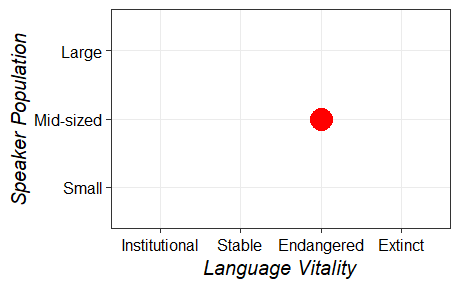 Click to enlarge with explanation
Place in Language Cloud
 Click to enlarge with explanation