
SIF ISO 639-3
Siamou
A language of Burkina Faso
- ISO 639
- sif
- Alternate Names
- Seme, Siemu, Siémou, Syémou, Sému
- Population
- 17,400 in Burkina Faso (2009 UNSD). Total users in all countries: 52,100.
- Location:
- Hauts-Bassins region: Houet province, Toussiana department; Kenedougou province: Orodara is center, Bandougou, Didéri, Diéri, Diéridéni, Diossogou, Kotoudéni, Lidara, and Tin villages.
- Language Status
- 6a* (Vigorous).
- Classification
- Niger-Congo, Atlantic-Congo, Volta-Congo, Kru, Seme
- Dialects
- Bandougou. Minor dialect differences between villages and within Orodara. The Bandougou dialect is considered different, but intelligibility among dialects seems adequate. No closely related languages.
- Typology
- SOV; postpositions; genitives, articles, personal pronouns before noun heads; adjectives, numerals after noun heads; question word final for yes-no questions; content question words appear in normal position: e.g., S-O-adverbial-O of prep; word order distinguishes subjects and objects; tonal (3 phonemic tones: High, Mid, Low and downstep; 7 different tone categories for monosyllabic words).
- Language Use
- Vigorous. Also use French [fra]. Also use Jula [dyu].
- Language Development
- Literacy rate in L2: A few in Jula [dyu], some in French [fra]. Grammar. Bible portions: 2009.
- Language Resources
- OLAC resources in and about Siamou
- Writing
- Latin script [Latn].
- Other Comments
- Previously classified as Mande. Their tradition says they came from the south. Traditional religion, Muslim.
Also Spoken in
- Location
- Bamako capital district.
- Language Status
- Unestablished
- Other Comments
- Non-indigenous. View other languages of Mali
Language Name
Siamou
User Population
34,700 in Mali (2018).
Map
Location: Hauts-Bassins region: Houet province, Toussiana department; Kenedougou province: Orodara is center, Bandougou, Didéri, Diéri, Diéridéni, Diossogou, Kotoudéni, Lidara, and Tin villages.
Size and Vitality
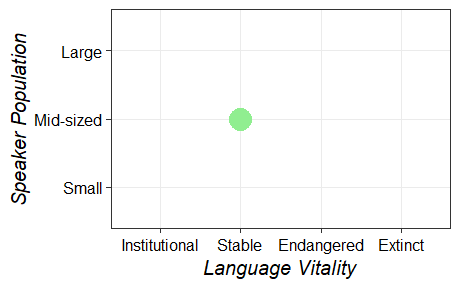 Click to enlarge with explanation
Place in Language Cloud
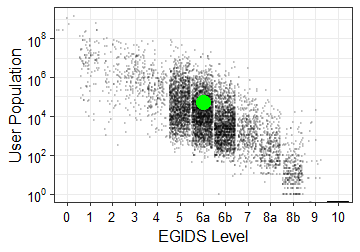 Click to enlarge with explanation