
SCS ISO 639-3
Slavey, North
Satúotine Yatí Autonym
A language of Canada
- ISO 639
- scs
- Alternate Names
- Dene, Dené, Esclave du Nord, Mackenzian, “Slave” (pej.), “Slavi” (pej.)
- Autonym
- Satúotine Yatí
- Population
- 770 (2016 census). Bearlake dialect: 580; Hare dialect: 145; Mountain dialect: 100 (Golla 2007). Ethnic population: 1,950 (Golla 2007). Bearlake dialect: 1,070. Hare dialect: 710. Mountain dialect: 170 (Golla 2007).
- Location:
- Northwest Territories: Mackenzie district, middle Mackenzie River from Fort Norman north, around Great Bear Lake; Colville Lake, Deline, Fort Good Hope, Norman Wells, and Tulita in Mackenzie Mountains; Yellowknife.
- Language Status
- 6b (Threatened). Statutory language of provincial identity in NWT (1988, NWT Official Languages Act, Chapter 56 (Supplemented), Section 4). Language of recognized indigenous peoples: Behdzi Ahda’, Deline, Fort Good Hope, Nahanni Butte, Ross River, Tulita Dene, Yellowknives Dene.
- Classification
- Eyak-Athabaskan, Athabaskan, Northern Athabaskan, Slavey-Hare
- Dialects
- Hare, Bearlake, Mountain Slavey. North and South Slavey [xsl] form a chain of related varieties. A member of macrolanguage Slave [den].
- Language Use
- Deline still has strong language use including young people. Decreasing use in other communities. Over half actively use it in the home. Some young people, all adults. All also use English [eng].
- Language Development
- Dictionary. Grammar.
- Language Resources
- OLAC resources in and about Slavey, North
- Writing
- Latin script [Latn]. Unified Canadian Aboriginal Syllabics script [Cans], no longer in use.
Also Spoken in
Map
Location: Northwest Territories: Mackenzie district, middle Mackenzie River from Fort Norman north, around Great Bear Lake; Colville Lake, Deline, Fort Good Hope, Norman Wells, and Tulita in Mackenzie Mountains; Yellowknife.
Size and Vitality
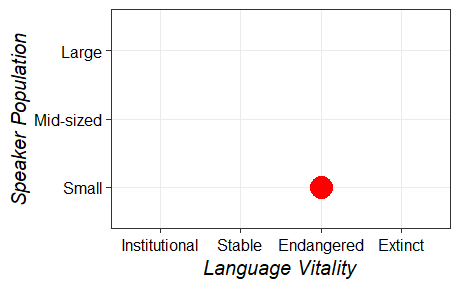 Click to enlarge with explanation
Place in Language Cloud
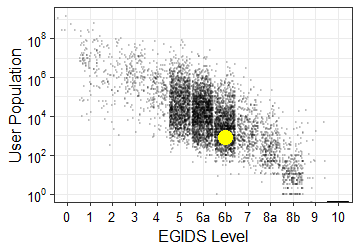 Click to enlarge with explanation