
SCI ISO 639-3
Sri Lankan Malay Creole
A language of Sri Lanka
- ISO 639
- sci
- Alternate Names
- Java Jati, Melayu Bahasa, Sri Lankan Malay
- Population
- 57,400 (2019), decreasing.
- Location:
- Ampara, Baddulla, Colombo, Galle, Gampaha, Hambantota, Jaffna, Kalutara, Kandy, Matara, Matale, Moneragala, and Nuwara Eliya districts, especially Badulla, Colombo, Hambantota, Kandy, and Kirinda urban areas.
- Language Status
- 6b (Threatened).
- Classification
- Creole, Malay based
- Dialects
- None known. Not intelligible of Standard Malay [zsm] due to phonological and syntactic differences, and strong influence from Tamil [tam]. May be similar to Malaccan Malay Creole [ccm] (Lim 1981).
- Typology
- SOV; postpositions; case; adjectives and genitives precede noun heads.
- Language Use
- Language shift taking place. Malay communities using either English [eng], Sinhala [sin], or Tamil [tam] favor Sri Lankan Malay Creole. Clear shift to English among youth in Colombo. Kirinda is the only vital community of Sri Lanka Malays who have youth who speak it as L1. There is also a desire to acquire Standard Malay [zsm] as a useful economic tool but still preserve Malay identity. Beginning to shift to Standard Malay even in Kirinda. Home, community. Some young people, all adults. All ages only in Kirinda; being lost by youth in every other community. Also use English [eng]. Also use Sinhala [sin]. Also use Standard Malay [zsm]. Also use Tamil [tam].
- Language Development
- Newspapers. Radio.
- Language Resources
- OLAC resources in and about Sri Lankan Malay Creole
- Writing
- Latin script [Latn].
- Other Comments
- Malay vocabulary with grammatical structure based on Sri Lankan Moor Tamil. Muslim, traditional religion.
Also Spoken in
Map
Location: Ampara, Baddulla, Colombo, Galle, Gampaha, Hambantota, Jaffna, Kalutara, Kandy, Matara, Matale, Moneragala, and Nuwara Eliya districts, especially Badulla, Colombo, Hambantota, Kandy, and Kirinda urban areas.
Size and Vitality
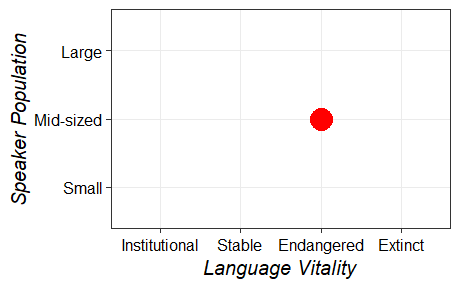 Click to enlarge with explanation
Place in Language Cloud
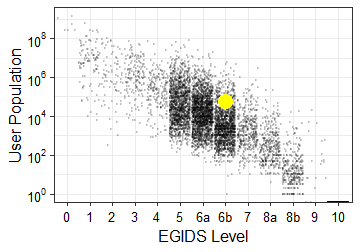 Click to enlarge with explanation