
RWM ISO 639-3
Amba
Kwamba Autonym
A language of Uganda
- ISO 639
- rwm
- Alternate Names
- Baamba, Bulebule, Hamba, Humu, Kihumu, Ku-Amba, Kuamba, Lubulebule, Lwamba, Ruwenzori Kibira, Rwamba
- Autonym
- Kwamba
- Population
- 42,600 in Uganda (2014 census), decreasing. Census based on tribal affiliation. Total users in all countries: 47,100.
- Location:
- Bundibugyo and Ntoroko districts: Ruwenzori mountains, Democratic Republic of the Congo border area south of Lake Albert.
- Language Status
- 6b (Threatened).
- Classification
- Niger-Congo, Atlantic-Congo, Volta-Congo, Benue-Congo, Bantoid, Southern, Narrow Bantu, Central, D, Lega-Holoholo (D.22)
- Dialects
- Kyanzi (Kihyanzi), Suwa (Kusuwa). Lexical similarity: 70% with Bira [brf], 57%–59% with Kaeku [kkq], Komo [kmw], and Bhele [bhy], 25% with Nande [nnb], 34% with Talinga-Bwisi [tlj].
- Typology
- 7 vowels, 24 consonants; tonal.
- Language Use
- Due to intermarriage, most Amba children grow up speaking Lubwisi [tlj]. Home. Some young people, all adults. Positive attitudes. All also use Talinga-Bwisi [tlj]. All also use Tooro [ttj]. Many also use English [eng]. Used as L2 by Mvuba [mxh].
- Language Development
- Literacy campaign in progress. Radio. Texts. Bible portions: 2004–2014.
- Language Resources
- OLAC resources in and about Amba
- Writing
- Latin script [Latn], used since 2009, in development.
- Other Comments
- Traditional religion, Christian.
Also Spoken in
- Location
- Nord-Kivu province: Uganda border area south of Lake Albert, northern Ruwenzori foothills.
- Dialects
- Kigumu (Hamba, Kuamba, Lubulebule), Kihyanzi, Kusuwa.
- Language Status
- 6b (Threatened) View other languages of Democratic Republic of the Congo
Language Name
Amba
User Population
4,500 in Democratic Republic of the Congo (1991 SIL).
Map
Location: Bundibugyo and Ntoroko districts: Ruwenzori mountains, Democratic Republic of the Congo border area south of Lake Albert.
Size and Vitality
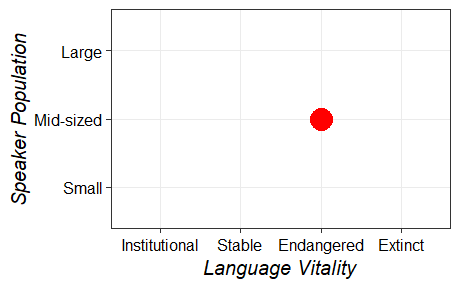 Click to enlarge with explanation
Place in Language Cloud
 Click to enlarge with explanation