
RAP ISO 639-3
Rapa Nui
Rapa Nui Autonym
A language of Chile
- ISO 639
- rap
- Alternate Names
- Easter Island, Pascuense, Rapanui
- Autonym
- Rapa Nui
- Population
- 1,000 (2016 R. Weber). Ethnic population: 5,000 (Kieviet 2016). Approximately 3,600 on Easter Island.
- Location:
- Valparaíso region: Easter Island, 3,800 km from Chile, 4,000 km from Tahiti.
- Language Status
- 6b (Threatened). Recognized language (1993, Indigenous Peoples Law (No. 19.253)).
- Classification
- Austronesian, Malayo-Polynesian, Central-Eastern Malayo-Polynesian, Eastern Malayo-Polynesian, Oceanic, Central-Eastern Oceanic, Remote Oceanic, Central Pacific, East Fijian-Polynesian, Polynesian, Nuclear, East, Rapanui
- Dialects
- None known. Lexical similarity: 64% with Hawaiian [haw], Mangareva [mrv], and Rarotongan [rar]; 63% with Marquesan [mrq]; 62% with Tahitian [tah] and Tuamotuan [pmt].
- Typology
- VSO; prepositions; noun head final; common and proper nouns; dual number; article; isolating language; aspect markers; 10 consonants and 10 vowels (5 short, 5 long); non-tonal; stress on penultimate syllable; inclusive/exclusive pronouns; verb serialization.
- Language Use
- Was vigorous, but now declining. Young generation losing interest in the language. Revival efforts are in progress (Wurm 2007). Home, education. Some young people, all adults. All also use Spanish [spa].
- Language Development
- Literacy rate in L1: 50%–75%. Literacy rate in L2: 80%–90% in Spanish [spa]. Literature. Radio. Dictionary. Grammar. NT: 2018. Agency: Academia de la Lengua Rapa Nui.
- Language Resources
- OLAC resources in and about Rapa Nui
- Writing
- Latin script [Latn].
Also Spoken in
Map
Location: Valparaíso region: Easter Island, 3,800 km from Chile, 4,000 km from Tahiti.
Size and Vitality
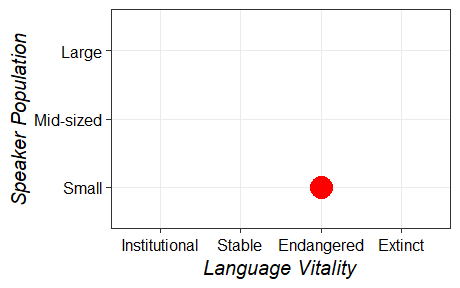 Click to enlarge with explanation
Place in Language Cloud
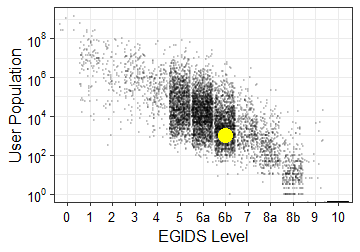 Click to enlarge with explanation