
QVZ ISO 639-3
Quichua, Northern Pastaza
Runa Shimi Autonym
A language of Ecuador
- ISO 639
- qvz
- Alternate Names
- Alama, Bobonaza Quichua, Canelos Quichua, Pastaza Quichua, Quichua del Oriente, Sarayacu Quichua
- Autonym
- Runa Shimi
- Population
- 8,000 in Ecuador (2007), decreasing. Total Quichua in Ecuador: 408,000 (Crevels 2012). 300 monolinguals. Total users in all countries: 10,000.
- Location:
- Pastaza province: eastern jungle along Bobonaza and Conambo rivers.
- Language Status
- 6b (Threatened).
- Classification
- Quechuan, Peripheral Quechua, Chinchay, Northern Chinchay
- Dialects
- Tigre Quechua. A member of macrolanguage Quechua [que].
- Typology
- SOV.
- Language Use
- Home, community, religion. Some of all ages. Negative attitudes. Most also use Spanish [spa]. Used as L2 by Achuar-Shiwiar [acu], Waorani [auc], Záparo [zro].
- Language Development
- Literacy rate in L1: 15%. Literacy rate in L2: 40% in Spanish [spa]. Any teaching done in Quichua uses Unified Quichua rather than the L1. NT: 1992–2009.
- Language Resources
- OLAC resources in and about Quichua, Northern Pastaza
- Writing
- Latin script [Latn].
- Other Comments
- Distinct from Southern Pastaza Quechua [qup] of Peru. Spanish [spa] is used for education. Traditional religion, Christian.
Also Spoken in
- Location
- Loreto region: Alamos, Tigre river.
- Language Status
- 6b (Threatened)
- Other Comments
- Distinct from Southern Pastaza Quechua [qup]. View other languages of Peru
Language Name
Quichua, Northern Pastaza
User Population
2,000 in Peru.
Map
Location: Pastaza province: eastern jungle along Bobonaza and Conambo rivers.
Size and Vitality
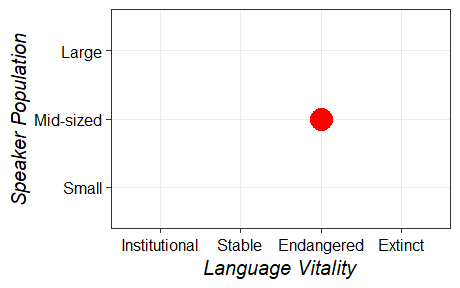 Click to enlarge with explanation
Place in Language Cloud
 Click to enlarge with explanation