
PMY ISO 639-3
Malay, Papuan
Melayu Papua Autonym
A language of Indonesia
- ISO 639
- pmy
- Alternate Names
- Bahasa Tanah, Logat Papua
- Autonym
- Melayu Papua
- Population
- 1,100,000 (Kluge 2014), all users. L1 users: 500,000 (Clouse 2000), increasing.
- Location:
- Widespread in coastal areas of the Papuan provinces.
- Language Status
- 3 (Wider communication). Used as a trade language in the 19th century and established further as an LWC by Dutch colonial language policies in early 20th century. Used as L2 by all living in coastal areas of the Papuan provinces.
- Classification
- Creole, Malay based
- Dialects
- North Papua Malay, Serui Malay, Bird’s Head Malay, South Coast Malay. Reportedly similar to both Ambonese Malay [abs] and Manado Malay [xmm]. Regional variations are minor and support at most a possible dialectal East-West divide (Scott et al 2008:22–100).
- Typology
- SVO, elision of arguments is common; 18 consonant and 5 vowel phonemes, disyllabic roots preferred, CV and CVC syllables preferred, maximal syllable is CCVC, typically penultimate syllable is stressed. Inflectional morphology is lacking; word formation is limited to reduplication which is very productive and affixation (limited productivity). Open word classes are nouns, verbs, and adverbs; closed classes are personal pronouns, interrogatives, demonstratives, locatives, numerals, quantifiers, prepositions, and conjunctions. Prepositions; clause final question particle.
- Language Use
- Growing number of L1 speakers, who express a strong preference for their Malay variety over Indonesian [ind] or other regional varieties. All domains except formal government settings or formal education. Used unofficially in many school settings. Used by all. Positive attitudes. Some also use Indonesian [ind]. Used as L2 by Ambel [wgo], As [asz], Awyi [auw], Beneraf [bnv], Berik [bkl], Betaf [bfe], Biak [bhw], Bian Marind [bpv], Biga [bhc], Bonggo [bpg], Burate [bti], Burumakok [aip], Buruwai [asi], Dabe [dbe], Dao [daz], Dineor [mrx], Dla [kbv], Emem [enr], Fedan [pdn], Jofotek-Bromnya [jbr], Kais [kzm], Kamberau [irx], Kaptiau [kbi], Kaure [bpp], Kayagar [kyt], Kayupulau [kzu], Kembra [xkw], Kimki [sbt], Kirikiri [kiy], Kowiai [kwh], Kuri [nbn], Kwesten [kwt], Kwinsu [kuc], Liki [lio], Masimasi [ism], Massep [mvs], Mawes [mgk], Mo [wkd], Mombum [mso], Morori [mok], Nafri [nxx], Nakai [nkj], Namla [naa], Nimboran [nir], Orya [ury], Salawati [xmx], Semimi [etz], Serui-Laut [seu], Skou [skv], Sobei [sob], Sowari [dmy], Sunum [ymn], Tangko [tkx], Tarpia [tpf], Tebi [dmu], Tobati [tti], Towei [ttn], Usku [ulf], Viid [snu], Vitou [vto], Wabo [wbb], Wamesa [wad], Warembori [wsa], Wares [wai], Wauyai [wuy], Yaosakor Asmat [asy], Yaur [jau], Yei [jei], Zorop [wfg].
- Language Development
- Literacy rate in L2: 67% in Indonesian [ind] in Papua province; 94% in Indonesian [ind] in Papua Barat province (2010 census). Officially no data on L1 literacy are available. Those literate in Indonesian [ind] can read and write Papuan Malay. Videos. Dictionary. Grammar. Bible portions: 2013–2017. Agency: Yayasan Betania Indonesia.
- Language Resources
- OLAC resources in and about Malay, Papuan
- Writing
- Latin script [Latn].
- Other Comments
- Christian, Muslim, traditional religion.
Also Spoken in
Map
Location: Widespread in coastal areas of the Papuan provinces.
Size and Vitality
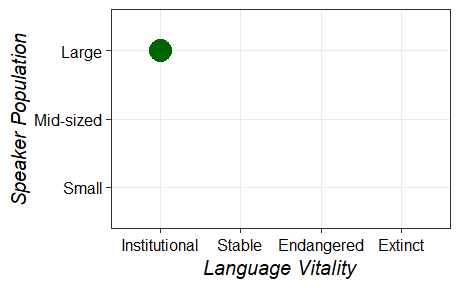 Click to enlarge with explanation
Place in Language Cloud
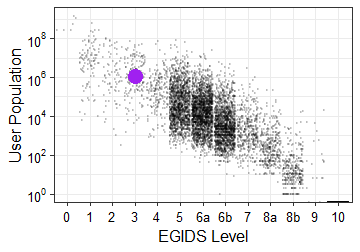 Click to enlarge with explanation