
PMS ISO 639-3
Piedmontese
Piemontèis Autonym
A language of Italy
- ISO 639
- pms
- Alternate Names
- Piemontese
- Autonym
- Piemontèis
- Population
- 700,000 in Italy (Regis 2012).
- Location:
- Lombardy region: small communities along Po river north bank, across from Valenza; Piedmont region: all provinces except Novara province, excluding Occitan- and Arpitan-speaking Alpine valleys; Valle d’Aosta region.
- Language Status
- 7 (Shifting).
- Classification
- Indo-European, Italic, Romance, Italo-Western, Western, Gallo-Iberian, Gallo-Romance, Gallo-Italian
- Dialects
- High Piedmontese (Alto Piemontese), Low Piedmontese (Basso Piemontese). Distinct enough from standard Italian [ita] to be considered a separate language. Considerable French [fra] influence.
- Language Use
- Use has diminished drastically among the young and in towns (Salminen 2007). Less than 27% of the informants in a 2012 census report use, within their family, a regional language of Northwestern Italy, including Piedmontese. All shifting to Italian [ita]. Used as L2 by Arpitan [frp], Occitan [oci], Walser [wae].
- Language Development
- Literacy rate in L2: 100% in Italian [ita]. NT: 1834.
- Language Resources
- OLAC resources in and about Piedmontese
- Writing
- Latin script [Latn].
Also Spoken in
- Language Status
- 9 (Dormant)
- Other Comments
- Non-indigenous. Emigrants from the Cuneo and Turin areas of Italy settled in Córdoba and Santa Fe provinces, especially during the late 19th and early 20th century. Piedmontese was in daily use in this area into the 1950s (Giolitto 2016). View other languages of Argentina
Language Name
Piedmontese
User Population
No known L1 speakers in Argentina. The language ceased to be used daily in the 1950s in favor of Spanish (Giolitto 2016); it may still be in use in major cities as a heritage language.
Map
Location: Lombardy region: small communities along Po river north bank, across from Valenza; Piedmont region: all provinces except Novara province, excluding Occitan- and Arpitan-speaking Alpine valleys; Valle d’Aosta region.
Size and Vitality
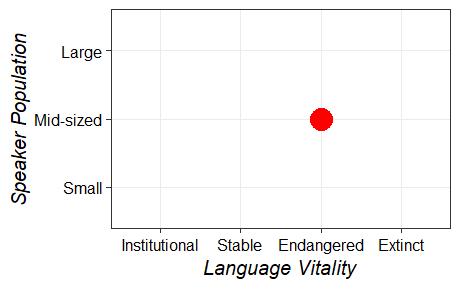 Click to enlarge with explanation
Place in Language Cloud
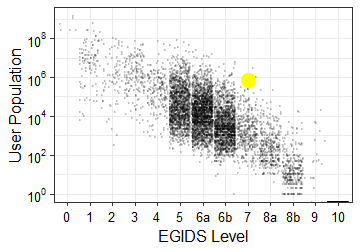 Click to enlarge with explanation