
PIS ISO 639-3
Pijin
Pijin Autonym
A language of Solomon Islands
- ISO 639
- pis
- Alternate Names
- Neo-Solomonic, Solomons Pidgin
- Autonym
- Pijin
- Population
- 564,000, all users. L1 users: 34,000 (2012 J. Leclerc). L2 users: 530,000 (2019).
- Location:
- Widespread.
- Language Status
- 3 (Wider communication). Originated on the sugar cane plantations in Queensland, Australia between 1863 and 1906; lingua franca spoken between Kanakas (Melanesian workers) and European overseers. In 1904, at end of labor trade period, repatriated Solomon Islanders brought pidgin to the Solomon Islands. Widely spoken by majority of population.
- Classification
- Creole, English based, Pacific
- Dialects
- Urban Pidgin. Basic vocabulary reportedly more similar to standard English [eng] than Tok Pisin [tpi] of Papua New Guinea is. Grammar shows Melanesian features. Historically related to Tok Pisin and Bislama [bis] of Vanuatu. Intelligibility of Bislama [bis] quite high.
- Language Use
- Many L1 speakers in the capital city, Honiara, are younger people, some of them well educated, who have developed their own way of speaking Pijin that is very fluid (2020 C. Jourdan). Creolization in progress. Also use English [eng]. Used as L2 by Äiwoo [nfl], Amba [utp], Asumboa [aua], Bilua [blb], Bughotu [bgt], Cheke Holo [mrn], Duke [nke], Engdewu [ngr], Fataleka [far], Hoava [hoa], Kusaghe [ksg], Lovono [vnk], Nalögo [nlz], Natügu [ntu], Noipä [npx], Savosavo [svs], Sikaiana [sky], Tanema [tnx], Teanu [tkw], To’abaita [mlu], Touo [tqu], Vaeakau-Taumako [piv].
- Language Development
- Literacy rate in L1: 30%–60%. Literacy rate in L2: 50%. Dictionary. Grammar. Bible: 2008.
- Language Resources
- OLAC resources in and about Pijin
- Writing
- Latin script [Latn].
Also Spoken in
Map
Location: Widespread.
Size and Vitality
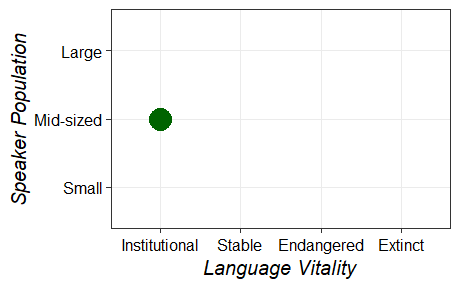 Click to enlarge with explanation
Place in Language Cloud
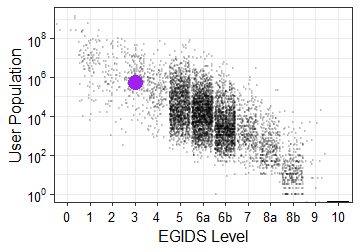 Click to enlarge with explanation