
PBU ISO 639-3
Pashto, Northern
پښتو (Pashto) Autonym
A language of Pakistan
- ISO 639
- pbu
- Alternate Names
- Pakhto, Pashtu, Pushto, Yousafzai Pashto, Yusufzai Pashto
- Autonym
- پښتو (Pashto)
- Population
- 25,300,000 in Pakistan (2017 census). Ethnic population: Possibly 49,600,000 Pashto in all countries. Total users in all countries: 29,785,800 (as L1: 27,785,800; as L2: 2,000,000).
- Location:
- Khyber Pakhtunkwa province: Peshawar district and Yusufzai area; Punjab province: Mianwali district; all along Afghanistan border.
- Language Status
- 4 (Educational).
- Classification
- Indo-European, Indo-Iranian, Iranian, Eastern, Southeastern, Pashto
- Dialects
- Ningraharian Pashto, Northeastern Pashto, Eastern Afghan Pashto. Much similarity with Northwestern Pashto in Afghanistan. Subdialects of Northeastern Pashto are Kohat (Khatak), Yusufzai (Peshawar), Afridi, Shinwari, Mohmand, Shilmani. Lexical similarity: 80% between Northeastern and Southwestern Pashto. A member of macrolanguage Pushto [pus].
- Typology
- SOV; noun head final; gender (masculine/feminine); no articles; case-marking (3 cases); verb affixes mark person, number, gender of subject; passives; tense and aspect; causatives.
- Language Use
- Rich literary tradition. The Powinda are a nomadic Pashto-speaking group. Used as L2 by Dameli [dml], Dari [prs], Gawar-Bati [gwt], Gawri [gwc], Indus Kohistani [mvy], Kalkoti [xka], Kamviri [xvi], Kati [bsh], Khowar [khw], Mankiyali [nlm], Palula [phl], Southern Hindko [hnd], Torwali [trw], Ushojo [ush].
- Language Development
- Literacy rate in L2: Low. Taught in primary schools. Literature. Newspapers. Periodicals. Radio. TV. Videos. Dictionary. Grammar. Texts. Bible: 2019.
- Language Resources
- OLAC resources in and about Pashto, Northern
- Writing
- Arabic script, Naskh variant [Arab], primary usage. Arabic script, Nastaliq variant [Aran].
- Other Comments
- Muslim.
Also Spoken in
- Location
- Scattered.
- Language Status
- 5 (Dispersed)
- Other Comments
- Non-indigenous. Came from Pakistan. Muslim. View other languages of United Arab Emirates
Language Name
Pashto, Northern
User Population
404,000 in United Arab Emirates (2020).
- Location
- Nangarhar province and surrounding regions; scattered.
- Dialects
- Ghilzai, Khogyani.
- Language Status
- 3 (Wider communication)
- Other Comments
- Non-indigenous. Pashto clans include: Mohmandi, Ghilzai, Durani, Yusufzai, Afridi, Kandahari (Qandahari), Waziri, Chinwari (Shinwari), Mangal, and Wenetsi. Muslim. View other languages of Afghanistan
Language Name
Pashto, Northern
User Population
5,000,000 in Afghanistan, all users. L1 users: 3,000,000 in Afghanistan (2017), increasing. L2 users: 2,000,000 (2020).
- Language Status
- Unestablished
- Other Comments
- Non-indigenous. View other languages of Australia
Language Name
Pashto, Northern
User Population
9,230 in Australia (2016 census). Census does not distinguish between Central Pashto [pst], Northern Pashto [pbu] and Southern Pashto [pbt].
- Language Status
- Unestablished
- Other Comments
- Non-indigenous. View other languages of Canada
Language Name
Pashto, Northern
User Population
16,900 in Canada (2016 census).
- Location
- Punjab state: Pathankot; Himachal Pradesh and Jammu and Kashmir states: where the 3 states meet in southwest Kashmir valley; Kupwara district, Changnar and Dhakki villages; Gujarat, Madhya Pradesh, and Maharashtra states; New Delhi; Uttar Pradesh: Rampur district.
- Language Status
- 6b (Threatened)
- Other Comments
- Non-indigenous. View other languages of India
Language Name
Pashto, Northern
User Population
21,700 in India (2011 census).
- Language Status
- Unestablished
- Other Comments
- Non-indigenous. View other languages of New Zealand
Language Name
Pashto, Northern
User Population
1,270 in New Zealand (2013 census).
- Language Status
- Unestablished
- Other Comments
- Non-indigenous. View other languages of Turkmenistan
Language Name
Pashto, Northern
User Population
9,900 in Turkmenistan (Leclerc 2019b). , based on ethnicity.
- Location
- Arizona; California; Colorado; Georgia; Illinois; Maryland; Massachusetts; Michigan; New Jersey; New York; North Carolina; Oklahoma; Oregon; Pennsylvania; Texas; Utah; Virginia; Washington.
- Language Status
- Unestablished
- Other Comments
- Non-indigenous. View other languages of United States
Language Name
Pashto, Northern
User Population
22,800 in United States (2015 census). Census does not distinguish between Central Pashto [pst], Northern Pashto [pbu] and Southern Pashto [pbt].
Map
Location: Khyber Pakhtunkwa province: Peshawar district and Yusufzai area; Punjab province: Mianwali district; all along Afghanistan border.
Size and Vitality
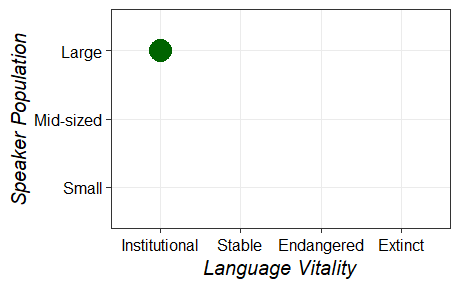 Click to enlarge with explanation
Place in Language Cloud
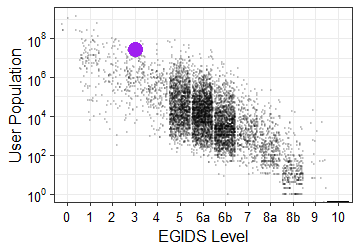 Click to enlarge with explanation