
OKI ISO 639-3
Okiek
A language of Kenya
- ISO 639
- oki
- Alternate Names
- Akie, Akiek, Kinare, Ogiek, “Ndorobo” (pej.)
- Population
- 50 L1 speakers in Kenya and Tanzania (Austin 2008). Spoken by a small number of people (Dimmendaal and Voeltz 2007). Ethnic population: 52,600 (2019 census). Total users in all countries: 250.
- Location:
- Nakuru county: east Mau escarpment. Mau forest between Amala and Ewas Ng’iro rivers near Nosogami stream (Sogoo dialect).
- Language Status
- 8b (Nearly extinct).
- Classification
- Nilo-Saharan, Satellite-Core, Core, Eastern Sudanic, Southern (n languages), Nilotic, Southern, Kalenjin, Okiek
- Dialects
- Okiek, Suiei, Sogoo (Sokoo). A member of macrolanguage Kalenjin [kln].
- Typology
- VSO; case-marking on nouns and adjectives (2 cases: nominative and accusative); verb affixes mark person and number of subject and object; aspect and tense affixes on verbs; 17 consonants and 10 vowels; tonal (3 - high, mid, low).
- Language Use
- Some languages associated with Okiek have few remaining speakers. Akiek in northern Tanzania now speak Maasai [mas]. Those of Kinare in Kenya now speak Gikuyu [kik]. Those in Tanzania and Kenya are not in contact with each other. Sogoo dialect may be extinct. Home, social gatherings. Many shifted to Maasai [mas] (Sommer 1992). Many shifted to Swahili [swh] (Sommer 1992). Also use English [eng].
- Language Resources
- OLAC resources in and about Okiek
- Writing
- Unwritten [Qaax].
- Other Comments
- “Ndorobo” is a pejorative term for several hunter or forest groups that are not linguistically related (El Molo, Yaaku, Okiek, Omotik, Aasáx). Christian.
Also Spoken in
- Location
- Manyara, Simiyu, and Tanga regions.
- Language Status
- 7 (Shifting)
- Other Comments
- Non-indigenous. Speakers in Tanzania and Kenya are not in touch with each other. View other languages of Tanzania
Language Name
Akie
User Population
250 in Tanzania (2016 K. Legere). Another 250 semi-speakers.
Map
Location: Nakuru county: east Mau escarpment. Mau forest between Amala and Ewas Ng’iro rivers near Nosogami stream (Sogoo dialect).
Size and Vitality
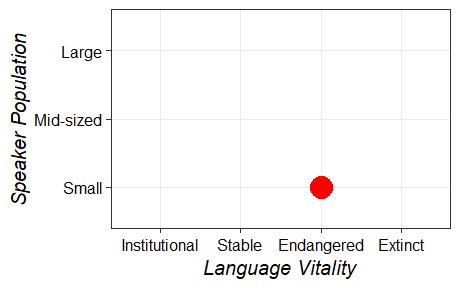 Click to enlarge with explanation
Place in Language Cloud
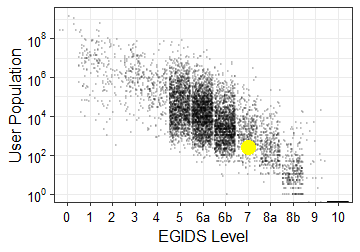 Click to enlarge with explanation