
NYO ISO 639-3
Nyoro
Runyoro Autonym
A language of Uganda
- ISO 639
- nyo
- Alternate Names
- Kyopi, Lunyoro
- Autonym
- Runyoro
- Population
- 967,000 (2014 census), increasing. Census based on tribal affiliation.
- Location:
- Buliisa, Hoima, Kibaale, Kiryandongo, and Masindi districts; also Kiboga, Kyankwanzi, Kyegegwa, and Kyenjojo districts east of Lake Albert.
- Language Status
- 4 (Educational).
- Classification
- Niger-Congo, Atlantic-Congo, Volta-Congo, Benue-Congo, Bantoid, Southern, Narrow Bantu, Central, J, Nyoro-Ganda (E.11)
- Dialects
- Rutagwenda, Orunyoro (Nyoro). 73% inherent intelligibility with Gungu [rub]. Hema-Sud [nyo] (Nyoro-Toro) in Democratic Republic of the Congo is quite different. Lexical similarity: 78%–93% with Tooro [ttj], 77% with Nyankore [nyn] and Chiga [cgg], 67% with Nyambo [now] and Zinza [zin], 66% with Haya [hay], 62% with Kerewe [ked].
- Typology
- SVO.
- Language Use
- Vigorous. Home, market, work. Used by all. Positive attitudes. Most also use English [eng]. Most also use Tooro [ttj], especially Rutangwenda speakers. Some also use Ganda [lug]. Used as L2 by Gungu [rub], Ruruuli-Runyala [ruc], Tooro [ttj].
- Language Development
- Taught in primary schools. Literature. Radio. Videos. Dictionary. Grammar. Texts. Bible: 1912.
- Language Resources
- OLAC resources in and about Nyoro
- Writing
- Latin script [Latn], used since 1978.
- Other Comments
- Standardized form of the western languages (Nyankore-Chiga and Nyoro-Tooro) is called Runyakitara. It is taught at the University and used in internet browsing, but is a hybrid language. Christian, traditional religion.
Also Spoken in
Map
Location: Buliisa, Hoima, Kibaale, Kiryandongo, and Masindi districts; also Kiboga, Kyankwanzi, Kyegegwa, and Kyenjojo districts east of Lake Albert.
Size and Vitality
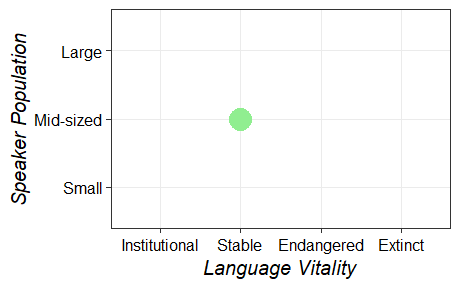 Click to enlarge with explanation
Place in Language Cloud
 Click to enlarge with explanation