
NXQ ISO 639-3
Naxi
Naqxi Autonym
A language of China
- ISO 639
- nxq
- Alternate Names
- Lomi, Mu, Nahsi, Nakhi, Nasi, “Mo-Su” (pej.), “Moso” (pej.), “Mosso” (pej.)
- Autonym
- Naqxi
- Population
- 300,000 (2000 census). 100,000 monolinguals. Ethnic population: 326,000 (2010 census).
- Location:
- Northwest Yunnan Province, a majority (over 200,000) in Yulong (formerly Lijiang) Naxi autonomous county. Some scattered through Weixi, Zhongdian, Ninglang, Deqing, Yongsheng, Heqing, Jianchuan, and Lanping counties. Some in Sichuan Province, Yanyuan, Yanbian, and Muli counties. A few in Tibet Autonomous Region, Mangkang county.
- Language Status
- 5 (Developing). Language of recognized nationality: Naxi. Official ethnic language of the Narua nationality.
- Classification
- Sino-Tibetan, Tibeto-Burman, Northeastern Tibeto-Burman, Naic
- Dialects
- Lapao, Lijiang, Ludian. Reportedly similar to Narua [nru].
- Typology
- SOV; no checked syllables; tonal, 4 tones (some sub-dialects have only 3 tones).
- Language Use
- Lijiang Old Town attitudes somewhat negative, decreasing number of young speakers. All domains. Used by all. Positive attitudes. Also use Central Bai [bca]. Also use Central Tibetan [bod]. Also use English [eng]. Also use Mandarin Chinese [cmn], in speaking and especially in writing. Used as L2 by Central Bai [bca], Central Tibetan [bod], Lisu [lis], Northern Pumi [pmi], Nuosu [iii], Shuhi [sxg], Southern Pumi [pmj].
- Language Development
- Literacy rate in L1: 5%. Literacy rate in L2: 40% in Mandarin Chinese [cmn]. Used as the medium of communication in several Naxi area primary schools. Taught in some schools as a subject for 1 or 2 years. Literature. Radio. TV. Videos. Dictionary. Grammar. Texts. Bible portions: 1932.
- Language Resources
- OLAC resources in and about Naxi
- Writing
- Latin script [Latn], developed in the 1950s and revised in 1984, primary usage. Lisu (Fraser) script [Lisu], experimental use in the 1920s and 1930s. Naxi Dongba script [Nkdb]. Naxi Geba script [Nkgb], no longer in use.
- Other Comments
- Official ethnic language of the Narua nationality. Buddhist, Confucianist, Daoist.
Also Spoken in
Map
Location: Northwest Yunnan Province, a majority (over 200,000) in Yulong (formerly Lijiang) Naxi autonomous county. Some scattered through Weixi, Zhongdian, Ninglang, Deqing, Yongsheng, Heqing, Jianchuan, and Lanping counties. Some in Sichuan Province, Yanyuan, Yanbian, and Muli counties. A few in Tibet Autonomous Region, Mangkang county.
Size and Vitality
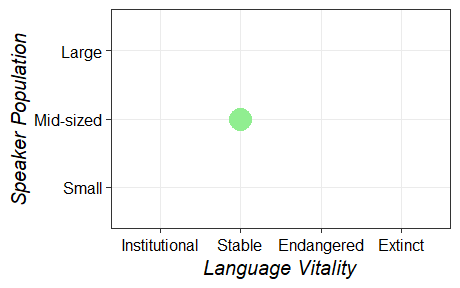 Click to enlarge with explanation
Place in Language Cloud
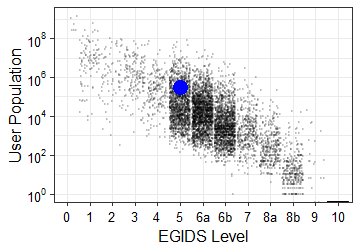 Click to enlarge with explanation