
NIO ISO 639-3
Nganasan
Ня” (Nja’), Ӈана”са (Ŋanaʿsa) Autonym
A language of Russian Federation
- ISO 639
- nio
- Alternate Names
- Nya, Tavgi Samoyed
- Autonym
- Ня” (Nja’), Ӈана”са (Ŋanaʿsa)
- Population
- 130 (2010 census). A group of about 100 lead a semi-nomadic life in Dudypta river region near Ust’-Avam (Salminen 2007). Ethnic population: 860 (2010 census).
- Location:
- Krasnoyarsk krai: Duinka region, Ust-Avam and Volochanka villages; Khatang region, Novaya village; northernmost people in Russia, Siberia, Taimyr peninsula.
- Language Status
- 7 (Shifting).
- Classification
- Uralic, Samoyed, Northern Samoyed
- Dialects
- Avam (West Nganasan), Khatang.
- Language Use
- Limited use in the home. Adults only. No child speakers (Leisiö 2006). Mixed attitudes, from neutral to mildly positive. Ethnic pride expressed and status enhanced by knowledge of Nganasan. Shifting to Russian [rus] (Leisiö 2006). Also use Dolgan [dlg]. Used as L2 by Tundra Enets [enh].
- Language Development
- Taught in primary schools as L2 to Avam-Nganasan children. Dictionary. Grammar.
- Language Resources
- OLAC resources in and about Nganasan
- Writing
- Cyrillic script [Cyrl].
- Other Comments
- 2 ethnic groups: Avam and Vadeyev. From 1960s–1980s resettled in villages formerly used as winter quarters or trading posts along migratory routes in 1940s. Previous intermittent contact with Tundra Enets and Nenets, and formerly officially were considered part of them. Resettlement brought close contact with Russian, Ukrainian [ukr], Belarusian [bel], and Tatar [tat]. Traditional religion.
Also Spoken in
Map
Location: Krasnoyarsk krai: Duinka region, Ust-Avam and Volochanka villages; Khatang region, Novaya village; northernmost people in Russia, Siberia, Taimyr peninsula.
Size and Vitality
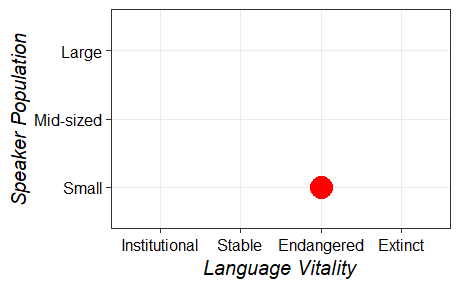 Click to enlarge with explanation
Place in Language Cloud
 Click to enlarge with explanation