
NEW ISO 639-3
Newar
नेपाल भाषा (Nepal Bhasa), नेवाः भाय् (Newah Bhay) Autonym
A language of Nepal
- ISO 639
- new
- Alternate Names
- Newa Bhaye, Newaah Bhaae, Newaah Bhaaye, Newah, Newal Bhaye, “Newari” (pej.)
- Autonym
- नेपाल भाषा (Nepal Bhasa), नेवाः भाय् (Newah Bhay)
- Population
- 879,600 in Nepal, all users. L1 users: 847,000 in Nepal (2011 census), decreasing. L2 users: 32,600 (2011 census). Many women are monolingual. Ethnic population: 1,260,000. Includes 1,245,000 Newar and 11,500 Pahari. Total users in all countries: 893,600 (as L1: 861,000; as L2: 32,600).
- Location:
- Bagmati province: Kathmandu valley; scattered throughout Gandaki, Janakpur, Kosi, and Lumbini provinces.
- Language Status
- 4 (Educational). Language of recognized indigenous nationality: Newar.
- Classification
- Sino-Tibetan, Tibeto-Burman, Western Tibeto-Burman, Himalayan, Central Himalayan, Newar
- Dialects
- Dolkhali (Dolakha), Sindhupalchok Pahari (Pahri), Totali, Citlang, Kathmandu-Patan-Kirtipur, Bhaktapur, Baglung, Badikhel Pahari (Pahri, Pihi), Gopali, Balami, Pyang Gaon (Gamal). Kirtipur and Lalitpur are reportedly similar to Kathmandu. Some vocabulary differences between Hindus and Buddhists. Bhaktapur people mostly understand Kathmandu despite some lexical differences. Balami and Citlang reported to not understand Kathmandu Newar. The Eastern Newar dialects, including at least Dolakha and Tauthali are not fully intelligible to the speakers of Kathmandu Valley where the language has a simple conjunct-disjunct agreement. Other dialects are also mutually unintelligible with Kathmandu Valley, including Pahari, Pyangaun, and perhaps other varieties as well. Dolakha variety has complex person-number verb agreement with residue reflex in the Pahari dialect of Badikhel. Pahari considered separate language within own communities.
- Typology
- SOV; postpositions; genitives, adjectives, demonstratives before noun heads; noun heads final; 4 noun classes: animate, inanimate, common, honored; content q-word in situ; relatives before and without noun heads; in polar questions there is a particle sentence finally; 1 prefix, up to 3 suffixes; clause constituents indicated by case-marking; verbal affixation marks person and number (in Dolakha and Badikhel dialects); affixes or clitics indicate case of noun phrases; ergative; causatives; comparatives; tense and aspect; no passives or voice; V, VC, CV, CVC, CCV, CCVC; nontonal; 28 consonant and 6 vowel phonemes.
- Language Use
- Language shift greater among Hindus than Buddhists. Home, religion; mixed use: Friends, work, education. Used by all. Also use Central Tibetan [bod]. Also use English [eng]. Also use Hindi [hin]. Also use Nepali [npi].
- Language Development
- Literacy rate in L1: 60% (1991 census). Literacy rate in L2: 60% (1991 census). Youth more literate than older; men more than women. Taught in primary and secondary schools. Literature. Newspapers. Periodicals. Radio. TV. Videos. Dictionary. Grammar. Texts. NT: 1986–2015. Agencies: Nepal Bhasa Academy; Newar National Forum.
- Language Resources
- OLAC resources in and about Newar
- Writing
- Devanagari script [Deva], primary usage. Newa script [Newa], in common use during the Malla period and earlier, recent efforts to revive usage. Ranjana (Lantsa, Wartu) script [Ranj], no longer in use.
- Other Comments
- One of the principal languages of Nepal; historically an official language of the Newar Malla Kings of the three cities of Kathmandu Valley. Kathmandu is the prestige dialect with most published materials. English [eng] highly valued; mixed feelings about Hindi [hin]; Tibetan [bod] does not have high prestige. People learn whichever language will help them economically: Nepali [npi], English [eng], Hindi [hin], and others. Hindu, Buddhist, traditional religion.
Also Spoken in
- Location
- Bihar state: some in Bettiah; Sikkim and West Bengal states.
- Language Status
- 6b (Threatened) View other languages of India
Language Name
Newar
User Population
14,000 in India (2007). Ethnic population: 166,000 (2007).
Map
Location: Bagmati province: Kathmandu valley; scattered throughout Gandaki, Janakpur, Kosi, and Lumbini provinces.
Size and Vitality
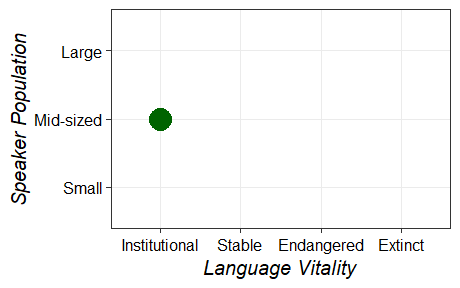 Click to enlarge with explanation
Place in Language Cloud
 Click to enlarge with explanation