
NDS ISO 639-3
Saxon, Low
Nedderdüütsch, Plattdüütsch Autonym
A language of Germany
- ISO 639
- nds
- Alternate Names
- Low German, Nedderdütsch, Neddersassisch, Nedersaksisch, Niederdeutsch, Niedersächsisch, Platt, Plattdeutsch
- Autonym
- Nedderdüütsch, Plattdüütsch
- Population
- 2,201,000 in Germany, all users. L1 users: 1,000 in Germany. L2 users: 2,200,000 (2016). Total users in all countries: 2,501,000 (as L1: 301,000; as L2: 2,200,000).
- Location:
- Niedersachsen state: north of a line from Aachen to Frankfurt an der Oder.
- Language Status
- 7 (Shifting). Statutory language of national identity (1998, ECRML, signed in November 1992 and ratified by the Federal Bundestag Implementation Act, Gazette, page 1314), There are also 6 states that concede recognized language status to Low Saxon/Low German, and 2 states, Schleswig-Holstein and Mecklenburg-Vorpommern, afford special protection to the language in their basic laws.
- Classification
- Indo-European, Germanic, West, Low Saxon-Low Franconian, Low Saxon
- Dialects
- Northern Low Saxon (Nordniedersächsisch, North Low Saxon), Eastphalian (Eastfalian, Ostfaelisch, Ostfälisch, Plattduitsch), Holsteinisch (Holsatian), Mecklenburg-Anterior Pomerania (Mecklenburgisch-Vorpommersch, Pomeranian), Mark-Brandenburg (East Prussian, Maerkisch-Brandenburgisch, Margravian, Märkisch-Brandenburgisch), Sleswickian (Schleswigsch). Listed dialects are in Germany. The first 3 dialects listed are Western Low Saxon, the other 2 are Eastern Low Saxon. Not intelligible to speakers of Standard German [deu]. A direct descendant of Old Saxon, related to English [eng]. 20 to 30 dialects with differing inherent intelligibility, depending on geographic distance. They did not experience the second consonantal shift of the 8th and 9th centuries (1976 J. Thiessen). Modern forms have been largely suppressed until recently and have received much Dutch [nld] or Frisian influence, depending on the area. Low Saxon varieties are listed separately in the Netherlands, where they have official status. Pomerano is used in Latin America. Westphalian [wep] and Plautdietsch [pdt] also have separate entries.
- Language Use
- Officially recognized as a regional (separate) language in 8 states of Germany. Recognized as a regional (separate) language by the European Charter on Languages. Adults only. Shifting to Standard German [deu]. Used as L2 by Northern Frisian [frr].
- Language Development
- Dictionary. Bible: 1478–1534.
- Language Resources
- OLAC resources in and about Saxon, Low
- Writing
- Latin script [Latn].
- Other Comments
- Printed fairly widely outside Europe, particularly in North and Latin America, Australia, Southern Africa, and Eastern Europe (Siberia, Kazakhstan).
Also Spoken in
- Location
- Espírito Santo: Domingos Martins, Laranja da Terra, Pancas, Santa Maria de Jetibá, and Vila Pavão; Rio Grande do Sul: Serra dos Tapes, Canguçu.
- Language Status
- 4 (Educational)
- Other Comments
- Developed from the East Pomeranian dialect of Low Saxon [nds], previously spoken in northern Poland. View other languages of Brazil
Language Name
Pomeranian
User Population
300,000 in Brazil (2016 M. Braga).
Map
Location: Niedersachsen state: north of a line from Aachen to Frankfurt an der Oder.
Size and Vitality
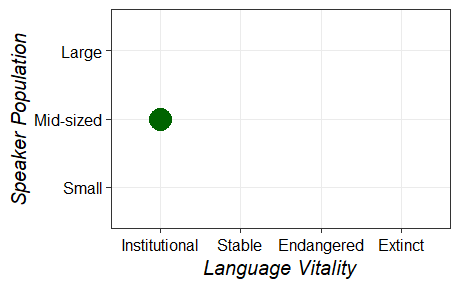 Click to enlarge with explanation
Place in Language Cloud
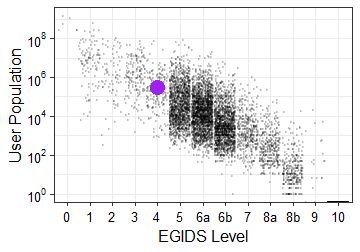 Click to enlarge with explanation