
NCA ISO 639-3
Iyo
Iyo Autonym
A language of Papua New Guinea
- ISO 639
- nca
- Alternate Names
- Bure, Nabu, Naho, Nahu, Ndo
- Autonym
- Iyo
- Population
- 6,900 (Minter 2009).
- Location:
- Madang province: Finisterre mountains’ south slopes along Nahu and Bure rivers; north slopes along Kipuro and Kasang rivers; Morobe province: northwest Markham district.
- Language Status
- 5 (Developing).
- Classification
- Trans-New Guinea, Finisterre-Huon, Finisterre, Gusap-Mot
- Dialects
- None known. Lexical similarity: 50% with Rawa [rwo] (Minter 2009).
- Typology
- SOV; Noun Classes: 2 (Possession, Person); Number: Singular, Dual, and Plural; Agglutinative morphology; Verb affixation marks person, number, object, tense, and aspect; Tenses: 4 (Remote Past, Past, Present, Future), Aspects: 6 (Continuative, Completive, Durative, Habitual, Perfective, Inceptive); Consonants: 17, Vowels: 5 (Minter 2009).
- Language Use
- Very stable on the inland side of the Finisterres because of isolation. On the coastal side, with more cross-language interaction, there is much more admixture with Tok Pisin [tpi]. All domains except church, where there is mixed use with Tok Pisin [tpi], and in interactions with outsiders. Used by all. Positive attitudes. Many also use Tok Pisin [tpi], especially men and young people (Minter 2009).
- Language Development
- Literacy rate in L1: Low. Literacy rate in L2: High. One vernacular preschool. All other vernacular preschools stopped operating in 2010. One elementary school spends a small amount of time on vernacular literacy, but there aren’t enough vernacular literacy materials and teaching for widespread L1 literacy. Literature. Texts. NT: 2009.
- Language Resources
- OLAC resources in and about Iyo
- Writing
- Latin script [Latn].
Also Spoken in
Map
Location: Madang province: Finisterre mountains’ south slopes along Nahu and Bure rivers; north slopes along Kipuro and Kasang rivers; Morobe province: northwest Markham district.
Size and Vitality
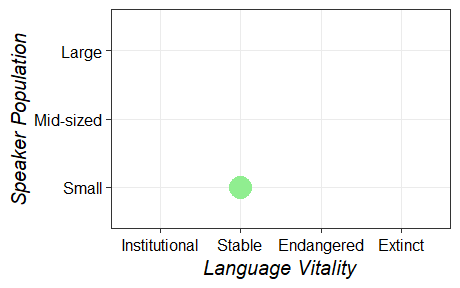 Click to enlarge with explanation
Place in Language Cloud
 Click to enlarge with explanation