
MRD ISO 639-3
Magar, Western
मगर ढुट (magar ḍhuṭ) Autonym
A language of Nepal
- ISO 639
- mrd
- Alternate Names
- Magar, Magari, Mangar, Mangari, Syangja Magar
- Autonym
- मगर ढुट (magar ḍhuṭ)
- Population
- 308,000 (2001 census), decreasing. 789,000 all Magar in Nepal (2011 census). Census statistics likely include non-ethnic Magars and many that do not speak Magar.
- Location:
- Gandaki province: East Nawalparasi district, northern hills; Syangja district, southern municipalities; Tanahun district, southern municipalities; Lumbini province: Palpa district, widespread.
- Language Status
- 6b (Threatened). Language of recognized indigenous nationality: Magar.
- Classification
- Sino-Tibetan, Tibeto-Burman, Western Tibeto-Burman, Himalayan, Central Himalayan, Kham-Magar, Magar
- Dialects
- Palpa, Syangja. Some differences between dialects, yet reportedly high intellligibility.
- Typology
- SOV; postpositions, but mostly case clitics; noun head final; alienable and inalienable noun classes; content q-word in situ; up to 3 prefixes, up to 7 suffixes; clause constituents indicated by case-marking; verbal affixation marks person and number; ergativity; tense and aspect; passives; nontonal; 33 to 37 consonant and 6 vowel phonemes.
- Language Use
- Mixed use: Home, friends, work. Some young people, all adults. Elderly. Some use among children, adolescents, young and older adults. Mixed attitudes. Rhetoric is positive but language conservation is generally not implemented. Most also use Nepali [npi].
- Language Development
- Literature. Newspapers. Periodicals. Radio. Videos. Dictionary. Grammar. Texts.
- Language Resources
- OLAC resources in and about Magar, Western
- Writing
- Devanagari script [Deva].
- Other Comments
- Traditional religion, Buddhist, Christian, Hindu.
Also Spoken in
Map
Location: Gandaki province: East Nawalparasi district, northern hills; Syangja district, southern municipalities; Tanahun district, southern municipalities; Lumbini province: Palpa district, widespread.
Size and Vitality
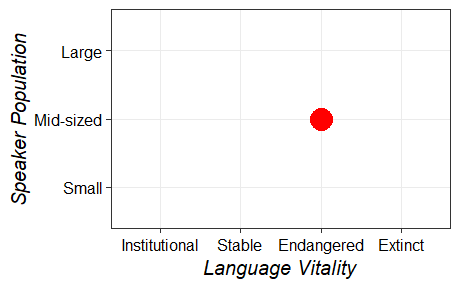 Click to enlarge with explanation
Place in Language Cloud
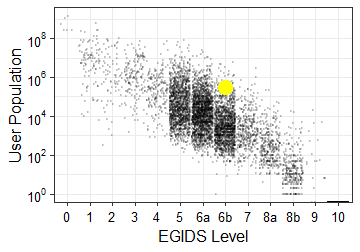 Click to enlarge with explanation