
MOH ISO 639-3
Mohawk
Kanien’kéha Autonym
A language of Canada
- ISO 639
- moh
- Alternate Names
- Kanien’kehaka
- Autonym
- Kanien’kéha
- Population
- 990 in Canada (2016 census). Ethnic population: 24,000 (1999 SIL). Total users in all countries: 3,040 (as L1: 2,940; as L2: 100).
- Location:
- Ontario province: Six Nations Reserve, Tyendinaga Reserve on Bay of Quinte near Kingston, and a small settlement at Wahta Mohawk Territory east of Georgian Bay; Quebec province: Kahnawà:ke and Kanehsatà:ke (Oka) near Montreal.
- Language Status
- 6b (Threatened). Language of recognized indigenous peoples: Bay of Quinte Mohawk, Lower Mohawk, Mohawks of Akwesasne, Mohawks of Kahnawá:ke, Mohawks of Kanesatake, Mohawks of the Bay of Quinte, Six Nations of the Grand River, Upper Mohawk, Wahta Mohawk, Walker Mohawk.
- Classification
- Iroquoian, Northern Iroquoian, Five Nations-Huronian-Susquehannock, Five Nations-Susquehannock, Mohawk-Oneida
- Language Use
- Some young people, all adults. Mostly older adults but a few children are native speakers (Golla 2007). Most also use English [eng].
- Language Development
- Literacy rate in L2: 75%–100%. Dictionary. Grammar. Bible portions: 1880–2004. Immersion schools in Kahnawà:ke and Kanehsatà:ke (Oka), on the Six Nations Reserve (Golla 2007).
- Language Resources
- OLAC resources in and about Mohawk
- Writing
- Latin script [Latn], used since 1993.
- Other Comments
- Kanien’kehaka is name for Mohawk people.
Also Spoken in
- Location
- New York: Saint Regis Reservation, north.
- Language Status
- 6b (Threatened) View other languages of United States
Language Name
Mohawk
User Population
2,050 in United States, all users. L1 users: 1,950 in United States (2015 census). L2 users: 100 (2011 M. Mithun). Ethnic population: 6,000 (1999 SIL).
Map
Location: Ontario province: Six Nations Reserve, Tyendinaga Reserve on Bay of Quinte near Kingston, and a small settlement at Wahta Mohawk Territory east of Georgian Bay; Quebec province: Kahnawà:ke and Kanehsatà:ke (Oka) near Montreal.
Size and Vitality
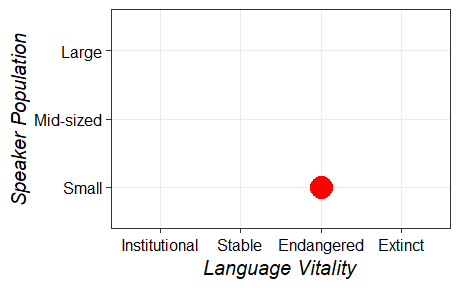 Click to enlarge with explanation
Place in Language Cloud
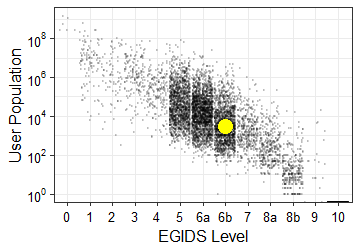 Click to enlarge with explanation