
MJG ISO 639-3
Tu
A language of China
- ISO 639
- mjg
- Alternate Names
- Mongor, Mongour, Monguor, Qighaan Mongghul
- Population
- 152,000 (2000 census), decreasing. Very few monolinguals. Ethnic population: 290,000 (2010 census).
- Location:
- Gansu province; Qinghai province: Hui, Huzhu Tu, and Minhe Tu autonomous counties.
- Language Status
- 7 (Shifting). Language of recognized nationality: Tu.
- Classification
- Mongolic, Eastern, Mongour
- Dialects
- Mongghul (Halchighol, Huzhu, Naringhol), Mangghuer (Minhe), Niandhu (Baoan, Nianduhu), Wutun. Reportedly most divergent of all Mongolian languages. Dialects reported not inherently mutually intelligible. Monggul (Huzhu) and Mangghuer (Minhe) may be two separate languages. Dongren Huzhu considered standard. Dialects of Huzhu: Halchi, Karlong and Naringhol.
- Typology
- SOV; postpositions; genitives, adjectives, numerals, and relative clauses precede head noun; question word appears in the position of the thing being questioned; verbs may bear up to 3 or 4 suffixes; word order distinguishes subject and direct object; topicalized noun phrases are often fronted; case is marked by enclitic postpositions; verbs are marked for the pragmatic category of perspective (a binary distinction between the perspective of the speaker and that of anyone else); causatives are extremely common; 26 consonants and 11 vowels, including phonemic length on 5 vowels); stress falls on the final syllable of a phonological word; no vowel harmony (in Mangghuer).
- Language Use
- Varies with location. Positive attitudes. Shifting to Mandarin Chinese [cmn]. Also use Central Tibetan [bod].
- Language Development
- Literacy rate in L1: About 2,000 can read, 200 can write. Literacy rate in L2: 77% literate in any language (2000 census, Tu nationality). Literature. Periodicals. Videos. Dictionary. Grammar. Texts.
- Language Resources
- OLAC resources in and about Tu
- Writing
- Latin script [Latn], pinyin-based.
- Other Comments
- Buddhist, traditional religion.
Also Spoken in
Map
Location: Gansu province; Qinghai province: Hui, Huzhu Tu, and Minhe Tu autonomous counties.
Size and Vitality
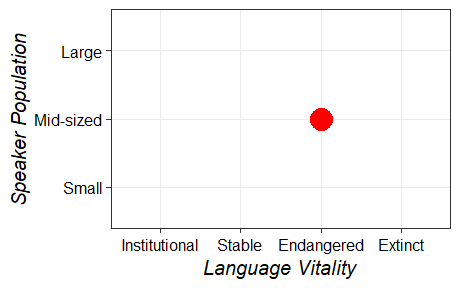 Click to enlarge with explanation
Place in Language Cloud
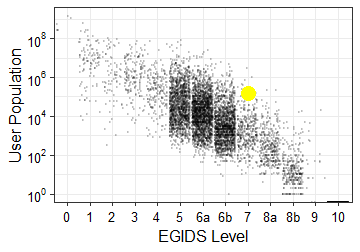 Click to enlarge with explanation