
MHS ISO 639-3
Buru
Buru Autonym
A language of Indonesia
- ISO 639
- mhs
- Alternate Names
- Boeroe, Buruese
- Autonym
- Buru
- Population
- 45,000 (Grimes 2010).
- Location:
- Maluku province: Buru island except northeast corner, 70 villages; some on Ambon island in Jakarta.
- Language Status
- 6b (Threatened).
- Classification
- Austronesian, Malayo-Polynesian, Central-Eastern Malayo-Polynesian, Central Maluku, Buru
- Dialects
- Masarete (South Buru), Wae Sama (Waesama), Central Buru (Rana, Wae Geren, Wae Kabo), Fogi (Li Emteban, Tomahu). Li Garan is a special taboo dialect spoken by the Rana people (3,000 to 5,000 users). Ethnic population Fogi dialect: 500, but no remaining speakers. Lexical similarity: 90% between Masarete and Wae Sama dialects, 88% between Masarete and Rana, 80% between Wae Sama and Rana, 68% between Lisela [lcl] and Masarete, 48% between Leliali dialect of Kayeli [kzl] and Masarete, 45% between Kayeli [kzl] and Masarete, 44% between Ambelau [amv] and Masarete, 27%–33% between Buru dialects and Sula [szn].
- Typology
- SVO; prepositions; genitives before nouns; predominantly head marking; CV, CVC, V, VC; nontonal.
- Language Use
- Vigorous in most areas. Fogi dialect speakers apparently shifted to Ambonese Malay [abs]. All domains. Some of all ages. Also use Ambonese Malay [abs]. Also use Indonesian [ind].
- Language Development
- Grammar. Bible portions: 1904–1998.
- Language Resources
- OLAC resources in and about Buru
- Writing
- Latin script [Latn].
- Other Comments
- There are word taboos and complex intermarriage patterns on the island. Exogamous. 10 clans. Christian, Muslim, traditional religion.
Also Spoken in
Map
Location: Maluku province: Buru island except northeast corner, 70 villages; some on Ambon island in Jakarta.
Size and Vitality
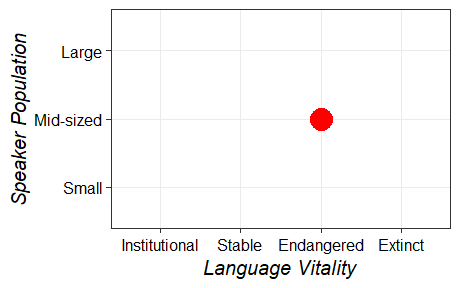 Click to enlarge with explanation
Place in Language Cloud
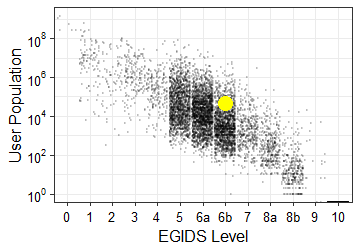 Click to enlarge with explanation