
MET ISO 639-3
Mato
Mato Autonym
A language of Papua New Guinea
- ISO 639
- met
- Alternate Names
- Nenaya, Nengaya, Nineia
- Autonym
- Mato
- Population
- 700 (Stober 2013).
- Location:
- Morobe province: Huon peninsula north coast, near Morobe-Madang provincial border, Uruwa river plain west of Wasu, north of Sapmanga, southeast of Saidor.
- Language Status
- 6a (Vigorous).
- Classification
- Austronesian, Malayo-Polynesian, Central-Eastern Malayo-Polynesian, Eastern Malayo-Polynesian, Oceanic, Western Oceanic, North New Guinea, Ngero-Vitiaz, Vitiaz, Roinji-Nenaya
- Dialects
- Ramuk, Tabares. Dialects are mutually intelligible. Lexical similarity: 54% with Uma [roe], 29%–32% with Pano [mqz] dialects, 28% with Karnai [bbv], 23% with Arop-Lokep [apr], 20% with Mala [mmt] (Stober 2013).
- Typology
- SVO; Prepositions, with one clitic postposition; Noun Head: Initial; Noun classes: 3 (Alienable, Inalienable, Local); Genders: None; Verbal affixation marks subject, object, causation, transitivity, distribution, intensity, direction, nominalization; Consonants: 16, Vowels: 5 (Stober 2013).
- Language Use
- Not endangered (2000 D. Tryon). All domains, except church. Used by all. Positive attitudes. Most also use Tok Pisin [tpi]. Used as L2 by Nukna [klt], Pano [mqz].
- Language Development
- Literacy rate in L1: 4%. Literacy rate in L2: 41%. Literature. Texts. NT: 2018.
- Language Resources
- OLAC resources in and about Mato
- Writing
- Latin script [Latn].
- Other Comments
- Christian, traditional religion.
Also Spoken in
Map
Location: Morobe province: Huon peninsula north coast, near Morobe-Madang provincial border, Uruwa river plain west of Wasu, north of Sapmanga, southeast of Saidor.
Size and Vitality
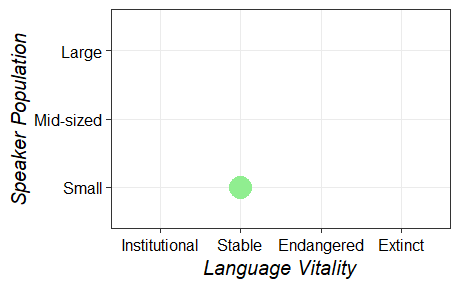 Click to enlarge with explanation
Place in Language Cloud
 Click to enlarge with explanation