
MAK ISO 639-3
Makasar
Basa Mangkasara’ Autonym
A language of Indonesia
- ISO 639
- mak
- Alternate Names
- Goa, Macassar, Macassarese, Makassa, Makassaarsche, Makassar, Makassarese, Mangasara, Mengkasara, Taena, Tena
- Autonym
- Basa Mangkasara’
- Population
- 2,110,000, all users. L1 users: 1,710,000 (2010 census), decreasing. L2 users: 400,000.
- Location:
- South Sulawesi province: Bantaeng, Gowa, Jeneponto, Maros, Pangkajene Dan Kepulauan, and Takalar regencies; southwest peninsula.
- Language Status
- 6b (Threatened).
- Classification
- Austronesian, Malayo-Polynesian, South Sulawesi, Makassar
- Dialects
- Lakiung (Goa, Gowa), Turatea (Jeneponto), Bantaeng (Maros-Pangkep, Marusu’-Pangkajene’). Gowa dialect is prestigious. Dialects form a chain.
- Typology
- Noun head initial, except demonstratives and some numerals; prepositions; definite marker; classifiers; passive marker; tense/aspect markers; 17 consonants and 5 vowels; stress on the penultimate syllable; inclusive/exclusive pronouns.
- Language Use
- Home, community, work (in rural areas). Some young people, all adults. Young people in the cities are shifting to Indonesian [ind] and Makassar Indonesian [mfp] (2019 B. Marshall). All also use Indonesian [ind]. Young people in the cities are shifting to Indonesian (2019 B. Marshall). All also use Makassar Indonesian [mfp]. Young people in the cities are shifting to Makassar Indonesian (2019 B. Marshall). Some also use Bugis [bug]. Used as L2 by Bugis [bug], Coastal Konjo [kjc].
- Language Development
- Taught in primary schools as a subject in some schools. Literature. Radio. Dictionary. Grammar. Texts. Bible: 1900–1999.
- Language Resources
- OLAC resources in and about Makasar
- Writing
- Buginese script [Bugi]. Latin script [Latn]. Makasar script [Maka], no longer in use.
- Other Comments
- Muslim.
Also Spoken in
Map
Location: South Sulawesi province: Bantaeng, Gowa, Jeneponto, Maros, Pangkajene Dan Kepulauan, and Takalar regencies; southwest peninsula.
Size and Vitality
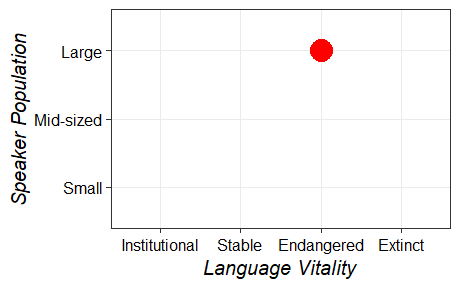 Click to enlarge with explanation
Place in Language Cloud
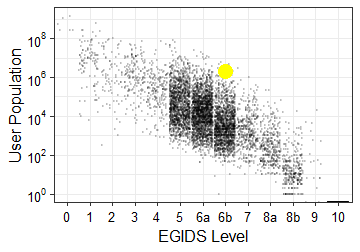 Click to enlarge with explanation