
MAI ISO 639-3
Maithili
मैथिली (Maithilī) Autonym
A language of India
- ISO 639
- mai
- Alternate Names
- Apabhramsa, Bihari, Maitili, Maitli, Methli, Tirahutia, Tirhuti, Tirhutia
- Autonym
- मैथिली (Maithilī)
- Population
- 30,000,000 in India (2000 SIL). 12,000,000 monolinguals (1998). Total users in all countries: 34,085,000 (as L1: 33,890,000; as L2: 195,000).
- Location:
- Bihar state: Muzaffarpur west, past Kosi east to west Purnia district, to Munger and Bhagalpur districts south, and Himalayan foothills north; Delhi, Kolkata, Mumbai. Cultural, religious, and linguistic centers are Janakpur, Madhubani and Darbhanga. Many settled abroad.
- Language Status
- 2 (Provincial). Statutory language of provincial identity in Bihar State (1992, Constitution, Amendment 71).
- Classification
- Indo-European, Indo-Iranian, Indo-Aryan, Outer Languages, Eastern, Bihari
- Dialects
- Standard Maithili, Southern Standard Maithili, Eastern Maithili (Khortha, Khotta, Kortha, Kortha Bihari), Western Maithili, Jolaha, Central Colloquial Maithili (Sotipura), Kisan, Dehati, Bajjika, Thetiya (Thati). Caste variation more than geographic variation in dialects. Functional intelligibility among all dialects, including those in Nepal. Reportedly most similar to Magahi [mag]. Lexical similarity: 91% between Brahmin and non-Brahmin dialects.
- Typology
- SOV; postpositions; noun head final; 11 noun classes or genders; content q-word in situ; genitives, articles, numerals before noun heads, adjectives before and after noun heads; 1 prefix, up to 5 suffixes; clause constituents partially indicated by case-marking (6 cases) and postpositions; verbal affixation marks person, number, gender, and honorificity of subject; nominative-accusative; object marked by position; person, gender, animate distinguished, obligatory for subject; transitives; both tense and aspect; passives and voice; causatives; comparatives; V, VC, VCC, CV, CVC, CVV, CCV, CVCC, CCVCC; non-tonal; 26 consonant and 16 vowel phonemes; stress on penultimate syllable.
- Language Use
- Used by Brahmin and other high caste or educated Hindus, who influence the culture and language, and other castes. There is a Maithili Academy. Linguistics and literature taught at Patna University and at L. N. Mithila University in Darbhanga. Home, community. Mixed attitudes. Influenced by caste, ranging from superiority to resentment; non-Brahmin speech viewed as inferior. Also use Bengali [ben]. Also use Bhojpuri [bho]. Also use English [eng]. Also use Hindi [hin]. Also use Nepali [npi].
- Language Development
- Literacy rate in L1: 25%–50%. Literacy rate in L2: 25%–50%. If they can read Nepali [npi] or Hindi [hin], they can read Maithili. The educated read Hindi, Nepali, or English books for pleasure. Some literacy work in India. Literature. Newspapers. Periodicals. Radio. TV. Videos. Dictionary. Grammar. NT: 2010.
- Language Resources
- OLAC resources in and about Maithili
- Writing
- Devanagari script [Deva], primary usage. Kaithi script [Kthi], used until the turn of the 20th century. Newa script [Newa], no longer in use, historic usage. Tirhuta script [Tirh], used until the turn of the 20th century.
- Other Comments
- Hindu.
Also Spoken in
- Location
- Janakpur province: widespread; Kosi province: Jhapa, Morang, Sunsari, and Udayapur districts.
- Dialects
- Bajjika, Bantar, Barei, Barmeli, Kawar, Kyabrat, Makrana, Tati, Dehati, Thenthi, Musahar. Dialect variation by caste (Brahmin vs. non-Brahmin) more than by geographic area. Functional intelligibility among all dialects. Bajjika listed as a separate language in Nepal census (2011); relationship with Maithili needs to be verified. Lexical similarity: 82–86% between Brahmin varieties in Morang, Saptari, Dhanusa and Sarlahi; 76–83% between non-Brahmin varieties in Morang, Saptari, Dhanusa and Sarlahi; 82–84% between Brahmin and non-Brahmin varieties in the same location.
- Language Status
- 5 (Dispersed)
- Other Comments
- Written variety considered standard. Hindi [hin] and its speakers considered close, culturally similar; Nepali [npi] accepted. Hindu, Christian. View other languages of Nepal
Language Name
Maithili
User Population
4,085,000 in Nepal, all users. L1 users: 3,890,000 in Nepal (2011 census), increasing. 793,000 Bajjika, 3,090,000 Maithili (2011 census). L2 users: 195,000 (2011 census).
Map
Location: Bihar state: Muzaffarpur west, past Kosi east to west Purnia district, to Munger and Bhagalpur districts south, and Himalayan foothills north; Delhi, Kolkata, Mumbai. Cultural, religious, and linguistic centers are Janakpur, Madhubani and Darbhanga. Many settled abroad.
Size and Vitality
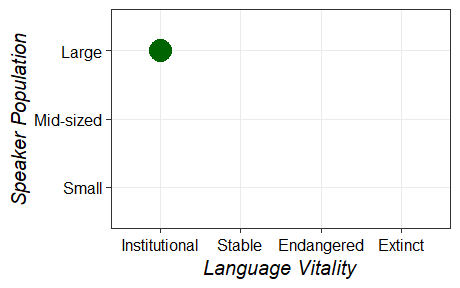 Click to enlarge with explanation
Place in Language Cloud
 Click to enlarge with explanation