
LWM ISO 639-3
Laomian
A language of China
- ISO 639
- lwm
- Alternate Names
- Bisu, Guba, Lawa, Lawmeh, Lua, Mbi, Mbisu, Mibisu, Misu, Pin
- Population
- 4,000 (Bradley 2007a), decreasing. Less than 1,000 Laopin (Bradley 2007a). Ethnic population: 5,000 (Bradley 2007a). Ethnic population does not include Laopin.
- Location:
- Yunnan province: Lancang, Menglian, and Ximeng counties. Menghai county, Mengzhe township, Van Phin (Laopinzhai) village (Laopin dialect).
- Language Status
- 6b (Threatened). Language of recognized nationality: Lahu.
- Classification
- Sino-Tibetan, Tibeto-Burman, Ngwi-Burmese, Ngwi, Southern, Bisoid
- Dialects
- Lanmeng, Laopin. Closely related to Pyen [pyy] and Bisu [bzi]; all 3 languages are largely mutually intelligible. Lexical similarity: 93%–95% between Laopin and Laomian, 88% with Bisu [bzi] in Thailand.
- Language Use
- Use of Chinese [cmn] is increasing and leading to language shift. Home, village. Some young people, all adults. Positive attitudes. Many also use Lahu [lhu]. Many also use Mandarin Chinese [cmn]. Also use Hani [hni]. Also use Lü [khb].
- Language Development
- Literacy rate in L2: 70%.
- Other Comments
- The name ‘Laomian’ is the Chinese derivation of the Lahu name ‘Lawmeh.’ Others officially classified as Undetermined Nationality. Some view Bisu as an important link to their culture and hope to preserve it. Traditional religion.
Also Spoken in
Map
Location: Yunnan province: Lancang, Menglian, and Ximeng counties. Menghai county, Mengzhe township, Van Phin (Laopinzhai) village (Laopin dialect).
Size and Vitality
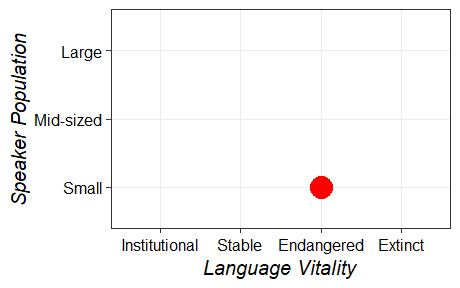 Click to enlarge with explanation
Place in Language Cloud
 Click to enlarge with explanation