
LRR ISO 639-3
Yamphu, Southern
A language of Nepal
- ISO 639
- lrr
- Alternate Names
- South Lorung, Southern Lohorung, Southern Lorung, Yamphu, “Yamphe” (pej.)
- Population
- 2,500 (2011 SIL), decreasing.
- Location:
- Kosi province: Dhankuta district, Chaubise municipality, Bodhe, Mounabudhuk, and Rajarani villages; Sangurigadhi municipality, Bhedetar village; Sankhuwasabha district, Chichila municipality, Devitar and Matsya Pokhari villages.
- Language Status
- 6b (Threatened). Language of recognized indigenous nationality: Rai.
- Classification
- Sino-Tibetan, Tibeto-Burman, Western Tibeto-Burman, Himalayan, Kiranti, Eastern
- Dialects
- None known. 61% intelligibility of Lohorung [lbr], 43%–58% (depending on site) intelligibility of Yamphu [ybi]. A Rai group, most closely related to Yamphu [ybi], but distinct in grammar and phonology (Hansson 1991). Lexical similarity: 84%–89% between Southern Yamphu varieties, 74%–83% with Yamphu [ybi], 65%–68% with Lohorung [lbr].
- Typology
- SOV; postpositions; verbal affixation marks person and number; tense; nontonal.
- Language Use
- Home, religion, work; mixed use: Friends. Some young people, all adults. Positive attitudes.
- Language Development
- Dictionary.
- Language Resources
- OLAC resources in and about Yamphu, Southern
- Writing
- Unwritten [Qaax].
- Other Comments
- Speakers of the language identify themselves ethnically as ‘Yamphu’. Hansson (1991) described this group as two separate languages, “Yamphu” and “Southern Lorung” (cf. Ethnologue, 16th edition and earlier). Traditional religion, Christian, Hindu.
Also Spoken in
Map
Location: Kosi province: Dhankuta district, Chaubise municipality, Bodhe, Mounabudhuk, and Rajarani villages; Sangurigadhi municipality, Bhedetar village; Sankhuwasabha district, Chichila municipality, Devitar and Matsya Pokhari villages.
Size and Vitality
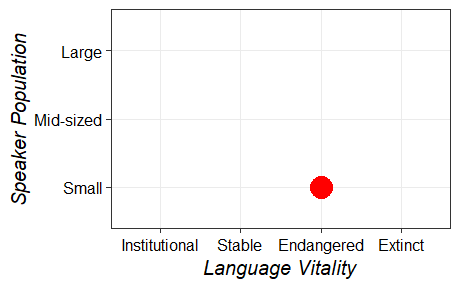 Click to enlarge with explanation
Place in Language Cloud
 Click to enlarge with explanation