
LIR ISO 639-3
Liberian English
A language of Liberia
- ISO 639
- lir
- Alternate Names
- Kolokwa, Liberian Pidgin English
- Population
- 5,113,000, all users. L1 users: 113,000 (2015). L2 users: 5,000,000 (2021 J. Sheppard).
- Location:
- Widespread.
- Language Status
- 3 (Wider communication). Brought to Liberia in 1822 by first group of black American emigrants who settled in Providence Island, now Monrovia. Trade language and used in informal contexts. Gained usage with five varieties and spread throughout Liberia in the 19th century.
- Classification
- Pidgin, English based, Atlantic
- Dialects
- Kru Pidgin English. Regional dialects. The variation in Liberian English today is mostly dependent on the educational level of the speaker, whether the speaker is from a rural or urban area, and whether Liberian English is their first or second language (Hancock 1974a).
- Language Use
- Used as L2 by Bandi [bza], Barclayville Grebo [gry], Bassa [bsq], Central Grebo [grv], Dan [dnj], Dewoin [dee], Eastern Krahn [kqo], Gbii [ggb], Gboloo Grebo [gec], Glaro-Twabo [glr], Glio-Oubi [oub], Gola [gol], Klao [klu], Konyanka Maninka [mku], Kuwaa [blh], Liberia Kpelle [xpe], Loma [lom], Maan [mev], Manya [mzj], Mende [men], Northern Grebo [gbo], Sapo [krn], Southern Grebo [grj], Southern Kisi [kss], Tajuasohn [tja], Tepo Krumen [ted], Vai [vai], Western Krahn [krw].
- Language Development
- Radio.
- Language Resources
- OLAC resources in and about Liberian English
- Writing
- Latin script [Latn], minimal usage.
- Other Comments
- As different from standard English as is Sierra Leone Krio [kri] repidginized from American Black English of the 1800s (Holm 1989).
Also Spoken in
Map
Location: Widespread.
Size and Vitality
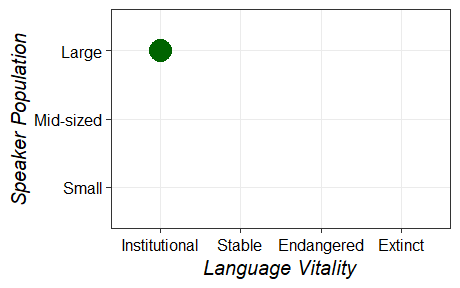 Click to enlarge with explanation
Place in Language Cloud
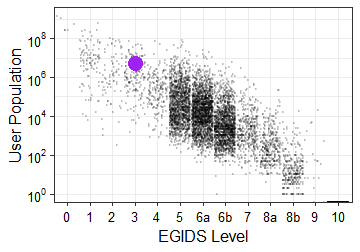 Click to enlarge with explanation