
LIN ISO 639-3
Lingala
Lingala Autonym
A language of Democratic Republic of the Congo
- ISO 639
- lin
- Alternate Names
- Ngala
- Autonym
- Lingala
- Population
- 40,000,000 in Democratic Republic of the Congo, all users. L1 users: 20,000,000 in Democratic Republic of the Congo (2021 M. Meeuwis). L2 users: 20,000,000 (2021 M. Meeuwis). Total users in all countries: 40,252,520 (as L1: 20,252,520; as L2: 20,000,000).
- Location:
- Widespread in Bas-Uele, Equateur, Haut-Uele, Kinshasa, Mai-Ndombe, Mongala, Nord-Ubangi, Orientale, Sud-Ubangi, and Tshopo provinces.
- Language Status
- 2 (Provincial). Statutory provincial language in northwestern regions (2006, Constitution, Article 1(8)). Developed as a trade language around 1900 about halfway between Kinshasa and Kisangani. It then spread along the river, ultimately becoming entrenched in Kinshasa, where it has become the L1 of most people.
- Classification
- Niger-Congo, Atlantic-Congo, Volta-Congo, Benue-Congo, Bantoid, Southern, Narrow Bantu, Northwest, C, Bangi-Ntomba (C.30)
- Dialects
- None known. Reportedly similar to Lusengo [lse] and Bangala [bxg]. Lexical similarity: 33% with Bobangi [bni].
- Typology
- SVO; prepositions; noun head initial; 12 noun classes; no articles; verb affixes mark person, number; passives; tense; causatives; 16 consonant and 5 vowel phonemes; tonal (2 tones: high, low); tendancy to vowel harmony.
- Language Use
- Used as L2 by Asoa [asv], Babango [bbm], Bali [bcp], Baloi [biz], Bamwe [bmg], Bangi [bni], Barambu [brm], Boko [bkp], Bolia [bli], Boloki [bkt], Bolondo [bzm], Bomboli [bml], Bomboma [bws], Bozaba [bzo], Budu [buu], Budza [bja], Bwa [bww], Dzando [dzn], Eboo Teke [ebo], Efe [efe], Foma [fom], Furu [fuu], Gbanziri [gbg], Gilima [gix], Gobu [gox], Ibali Teke [tek], Kango [kty], Kango [kzy], Kele [khy], Komo [kmw], Kpala [kpl], Lalia [lal], Libinza [liz], Ligenza [lgz], Likila [lie], Lobala [loq], Lombo [loo], Lusengo [lse], Ma [msj], Mayeka [myc], Mayogo [mdm], Mba [mfc], Mbandja [zmz], Mbesa [zms], Mid-Southern Banda [bjo], Moingi [mwz], Mongo-Nkundu [lol], Mono [mnh], Monzombo [moj], Ndaka [ndk], Ndobo [ndw], Ndolo [ndl], Ndunga [ndt], Ngando [nxd], Ngbaka [nga], Ngbaka Ma’bo [nbm], Ngbundu [nuu], Ngelima [agh], Ngombe [ngc], Northern Ngbandi [ngb], Ntomba [nto], Nzakara [nzk], Pagibete [pae], Poke [pof], Sakata [skt], Sengele [szg], So [soc], South Central Banda [lnl], Southern Ngbandi [nbw], Tembo [tmv], Tiene [tii], Togbo-Vara Banda [tor], Yango [yng].
- Language Development
- Literacy rate in L1: 70%. Used in church-based adult literacy programs (2021 SIL). Dictionary. Grammar. Bible: 1970–2000.
- Language Resources
- OLAC resources in and about Lingala
- Writing
- Latin script [Latn].
Also Spoken in
- Language Status
- Unestablished
- Other Comments
- Non-indigenous. View other languages of Belgium
Language Name
Lingala
User Population
20,100 in Belgium (2013 census).
- Language Status
- Unestablished
- Other Comments
- Non-indigenous. View other languages of Canada
Language Name
Lingala
User Population
3,810 in Canada (2016 census).
- Language Status
- Unestablished
- Other Comments
- Non-indigenous. View other languages of Central African Republic
Language Name
Lingala
User Population
10,700 in Central African Republic (2000).
- Location
- Mainly Brazzaville and surrounding areas in Pool department.
- Language Status
- 3 (Wider communication)
- Other Comments
- Traditional religion, Christian. View other languages of Congo
Language Name
Lingala
User Population
213,000 in Congo (2018).
- Language Status
- Unestablished
- Other Comments
- Non-indigenous. View other languages of United Kingdom
Language Name
Lingala
User Population
4,910 in United Kingdom (2011 census).
Map
Location: Widespread in Bas-Uele, Equateur, Haut-Uele, Kinshasa, Mai-Ndombe, Mongala, Nord-Ubangi, Orientale, Sud-Ubangi, and Tshopo provinces.
Size and Vitality
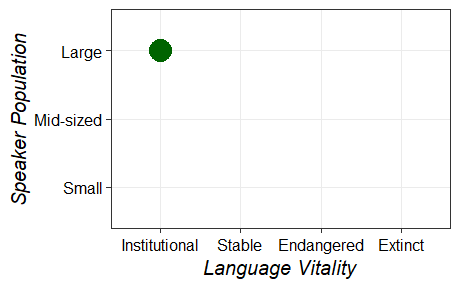 Click to enlarge with explanation
Place in Language Cloud
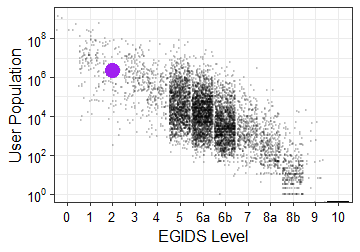 Click to enlarge with explanation