
KZQ ISO 639-3
Kaike
A language of Nepal
- ISO 639
- kzq
- Alternate Names
- Magar Kaike, Tarali Kham
- Population
- 2,000 (2011 A. Regmi), decreasing. No monolinguals. Ethnic population: 2,000 (2011 A. Regmi).
- Location:
- Karnali province: Dolpa district, Kaike municipality, Belawa, Shahartara, Tarakot, and Tupatara villages.
- Language Status
- 6a (Vigorous).
- Classification
- Sino-Tibetan, Tibeto-Burman, Western Tibeto-Burman, Bodish, West Bodish
- Typology
- SOV; postpositions; noun head final; no noun classes or genders; content q-word in situ; 1 prefix, up to 2 suffixes; clause constituents indicated by case-marking; consistently ergative; no passives or voice; semi-tonal; 29 consonant and 10 vowel phonemes; complex conjunct-disjunct system, and nominalization.
- Language Use
- Vigorous. Home, friends, religion, work; mixed use: Education. Used by all. Positive attitudes. Also use Central Tibetan [bod], especially for trade and commerce with the Dolpo. Also use Dolpo [dre]. Also use Nepali [npi].
- Language Development
- Texts.
- Language Resources
- OLAC resources in and about Kaike
- Writing
- Unwritten [Qaax].
- Other Comments
- Kaike is sometimes known as Tarali Kham, though it is quite different from Kham, a Himalayan language of western Nepal. (Bradley 1997:11). Buddhist, Hindu.
Also Spoken in
Map
Location: Karnali province: Dolpa district, Kaike municipality, Belawa, Shahartara, Tarakot, and Tupatara villages.
Size and Vitality
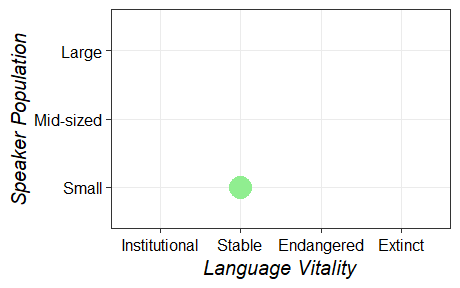 Click to enlarge with explanation
Place in Language Cloud
 Click to enlarge with explanation