
KVK ISO 639-3
Korean Sign Language
A language of South Korea
- ISO 639
- kvk
- Alternate Names
- Hanguk Sueo, Hanguk Suhwa Eoneo, KSL
- Population
- 180,000 in South Korea (2008 WFD). Approximately 0.4% of total population. Total users in all countries: 308,000.
- Location:
- Scattered.
- Language Status
- 4 (Educational). Recognized language (2016, Korean Sign Language Act), Requires a KSL Development Plan every five years, promotion of standardization, use of KSL in education, promotion in other areas of life, competency testing, and interpreters.
- Classification
- Sign language, Deaf community sign language
- Dialects
- None known. Related to Japanese [jsl] and Taiwanese [tss] sign languages. Exact amount of difference with the sign language variety in North Korea is unknown, but some reports indicate substantial communication problems between the two varieties, so they might need to be recognized as separate languages.
- Typology
- Finger-spelling system.
- Language Use
- Used since 1889. Signed interpretation required in court, used at important public events, and social services programs. Instruction for parents of deaf children. Many sign language classes for hearing people. Some also use Korean [kor].
- Language Development
- Primary schools for deaf children using sign language since 1908. TV. Dictionary. Agencies: Korea Association of the Deaf; National Institute of the Korean Language.
Also Spoken in
- Location
- Scattered.
- Dialects
- North Korean variety.
- Language Status
- 5 (Dispersed)
- Other Comments
- Anecdotal reports suggest that the sign language in North Korea is substantially different from that in South Korea, and may need to be recognized as a separate language. View other languages of North Korea
Language Name
Korean Sign Language
User Population
128,000 in North Korea (2021 DBS/DOOR/SIL). Estimated 75,000–150,000 deaf signers, assuming 0.3%–0.6% of total population.
Map
Location: Scattered.
Size and Vitality
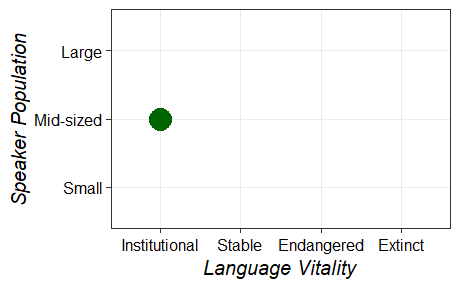 Click to enlarge with explanation
Place in Language Cloud
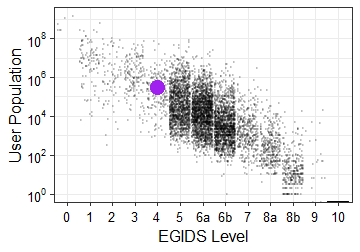 Click to enlarge with explanation