
KNP ISO 639-3
Kwanja
Kwànjâ Autonym
A language of Cameroon
- ISO 639
- knp
- Alternate Names
- Kondja, Konja
- Autonym
- Kwànjâ
- Population
- 10,000 (2011 LBT).
- Location:
- Adamawa region: most south of Banyo between Mayo Darle and Bankim, west to Mbojdanga, east to Mbam river.
- Language Status
- 5* (Developing).
- Classification
- Niger-Congo, Atlantic-Congo, Volta-Congo, Benue-Congo, Bantoid, Northern, Mambiloid, Mambila-Konja, Konja
- Dialects
- Ndung (Ndǔŋ, Ndungani), Sundani (Súndànɨ́, Sun), Njanga (Njang), Twendi. Njanga dialect has only 4 to 10 remaining speakers (Griffiths and Robson 2010). Two other Kwanja dialects are mutually intelligible for those who are in the Kwanja home area where they hear both dialects, more difficult for those who have not heard the other dialect: Sundani dialect is reportedly similar to Mambila [mcu]; Ndung dialect is similar to Vute [vut]. Twendi is the most divergent dialect, ethnically Kwanja, but linguistically more similar to Mambila [mcu].
- Typology
- SVO; prepositions; noun head initial in noun phrases; only remnants of noun classes; content-questions words phrase initial; no prefixes, up to 2 suffixes; clause constituents marked by word order; tense and aspect; 22 consonant and 9 vowel phonemes; 4 tones.
- Language Use
- Regular use in Kwanja area. Home, community. Positive attitudes, though in some places there is pressure to use Fulfulde [fub]. A few also use French [fra], especially those who work in cities outside the language area. Used as L2 by Tikar [tik], Twendi [twn].
- Language Development
- Literature. Newspapers. Dictionary. Texts. NT: 2006.
- Language Resources
- OLAC resources in and about Kwanja
- Writing
- Latin script [Latn].
- Other Comments
- Christian, Muslim, traditional religion.
Also Spoken in
Map
Location: Adamawa region: most south of Banyo between Mayo Darle and Bankim, west to Mbojdanga, east to Mbam river.
Size and Vitality
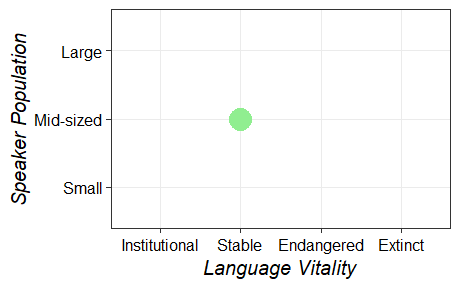 Click to enlarge with explanation
Place in Language Cloud
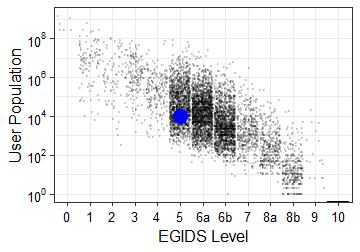 Click to enlarge with explanation