
KNB ISO 639-3
Kalinga, Lubuagan
Lubuagan Autonym
A language of Philippines
- ISO 639
- knb
- Autonym
- Lubuagan
- Population
- 30,000 (2008 V. Dumatog), increasing. 113,000 all Kalinga (2005 UNSD).
- Location:
- Cordillera Administrative Region: Baguio city, Kalinga province, Lubuagan, Tabuk city; National Capital Region: Manila.
- Language Status
- 4 (Educational).
- Classification
- Austronesian, Malayo-Polynesian, Northern Luzon, Meso-Cordilleran, South-Central Cordilleran, Central Cordilleran, North Central Cordilleran, Kalinga-Itneg, Kalinga
- Dialects
- Guinaang, Ableg-Salegseg, Balatok-Kalinga (Balatok-Itneg). Intelligibility of Balbalasang dialect 81%, Sumadel [ksc] 82%, Limos [kmk] 70%, 48% comprehension of Ilocano [ilo] narrative. Lexical similarity: 81% with Balbalasang and Limos.
- Typology
- VSO; prepositions; genitives before noun heads; articles, adjectives, and numerals normally before noun heads; relatives after noun heads; question word in sentence-initial position; 3 maximum suffixes; word order distinguishes subjects, objects, and indirect objects, and given and new information, topic and comment; affixes do not indicate case of noun phrases; verb affixes mark number; passives; causatives; comparatives; CV, CVC; nontonal.
- Language Use
- All domains. Used by all. Positive attitudes. Also use English [eng]. Also use Ilocano [ilo]. Also use Tagalog [tgl].
- Language Development
- Literacy rate in L1: 90%. Literacy rate in L2: 80%. Taught in primary schools. Literature. Dictionary. Texts. NT: 2013.
- Language Resources
- OLAC resources in and about Kalinga, Lubuagan
- Writing
- Latin script [Latn], in development.
- Other Comments
- Traditional religion, Christian.
Also Spoken in
Map
Location: Cordillera Administrative Region: Baguio city, Kalinga province, Lubuagan, Tabuk city; National Capital Region: Manila.
Size and Vitality
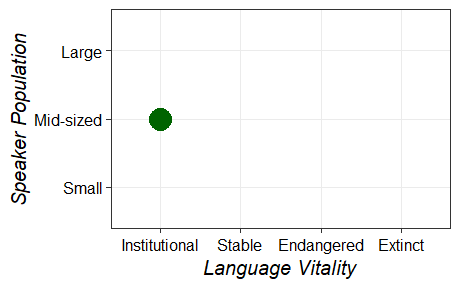 Click to enlarge with explanation
Place in Language Cloud
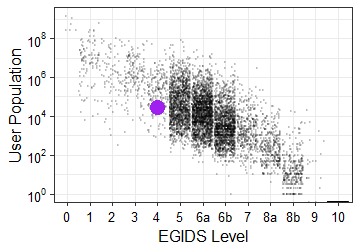 Click to enlarge with explanation