
KHQ ISO 639-3
Songhay, Koyra Chiini
A language of Mali
- ISO 639
- khq
- Alternate Names
- Songai, Songhai, Songhay, Songhoy, Songoi, Songoy, Sonrai, Sonrhai, Timbuktu Songhoy, West Songhoy
- Population
- 200,000 (1999 SIL), increasing.
- Location:
- Mopti region: Douentza and Youvarou circles; northeast Ségou region: Niono circle, northeast to Niger river; Tombouctou region: Niger river, both banks.
- Language Status
- 5 (Developing).
- Classification
- Nilo-Saharan, Songhai, Southern
- Dialects
- Koyra Chiini, Djenné Chiini. Main dialect division between Timbuktu and the upriver towns from Diré to Niafunké. Very distinct in Djenné city. Lexical similarity: 77% with Gao and Timbuktu dialects, 50% lexical similarity with Tadaksahak [dsq].
- Typology
- Kaado (Zarma dialect in Niger) is SOV, West Songhay SVO. Djenné Chiini phonology, lexicon, basic inflection almost identical to Koyra Chiini, but syntax (especially relativization and focalization) very different; Djenné has 7 vowels to 5 for Koyra Chinni (1999 J. Heath); Kaado has 3 tones, West Songhay no tones.
- Language Use
- Used by all. Positive attitudes. Timbuktu has more prestige than other West Songhoy dialects. Also use Bamanankan [bam]. Also use French [fra]. Also use Hassaniyya [mey]. Also use Tamasheq [taq]. Used as L2 by Tiemacèwè Bozo [boo].
- Language Development
- Taught in primary schools. Literature. Dictionary. Grammar. NT: 1936–2017.
- Language Resources
- OLAC resources in and about Songhay, Koyra Chiini
- Writing
- Latin script [Latn].
- Other Comments
- Muslim, traditional religion.
Also Spoken in
Map
Location: Mopti region: Douentza and Youvarou circles; northeast Ségou region: Niono circle, northeast to Niger river; Tombouctou region: Niger river, both banks.
Size and Vitality
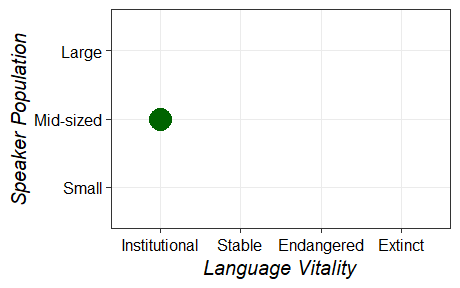 Click to enlarge with explanation
Place in Language Cloud
 Click to enlarge with explanation