
JSL ISO 639-3
Japanese Sign Language
A language of Japan
- ISO 639
- jsl
- Alternate Names
- JSL, NS, NSG, Nihon Shuwa, Nihon Shuwa Gengo, Shuwa, Temane
- Population
- 126,000 (2021 DBS/DOOR/SIL). Estimate assuming 0.1% of total population. Other estimates vary widely: 23,900 (2008 WFD); 317,000 (Van Cleve 1986).
- Location:
- Scattered.
- Language Status
- 5 (Developing). Recognized language (2013, Basic Act of Persons with Disabilities), guarantees the opportunity to choose ‘sign language’, but no further details.
- Classification
- Sign language, Deaf community sign language
- Dialects
- Related to Taiwanese [tss] and Korean [kvk] sign languages. Some regional variation within Japan.
- Language Use
- Vigorous. Over 95% of the deaf understand Japanese Sign Language. 107 deaf schools. The first school opened in Kyoto in 1878. Used by all. Also use Japanese [jpn].
- Language Development
- TV. Dictionary. Bible portions: 1993–2018.
- Other Comments
- ‘Shuwa’ (sign language) is the most common name in Japan; ‘Nihon Shuwa’ (NS, Japanese Sign Language) is used primarily by linguists, although many linguists use the English name and abbreviation; ‘Temane’ (gesturing) is a former name, not commonly used today. Signed Japanese is distinct from NS (but not always recognized as such), and is used often in formal situations, lectures, speeches, schools, and for interaction with hearing people. ‘Nihon Shuwa Gengo’ (NSG) is a fairly recent invention by the Japanese Federation of the Deaf that is intended to encompass both NS and Signed Japanese. 80% of the deaf understand fingerspelling.
Also Spoken in
Map
Location: Scattered.
Size and Vitality
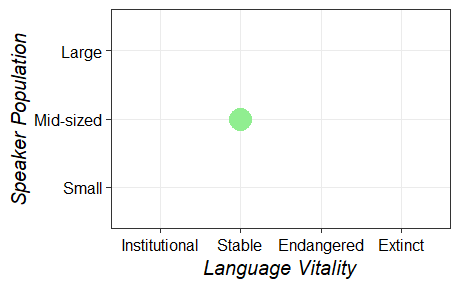 Click to enlarge with explanation
Place in Language Cloud
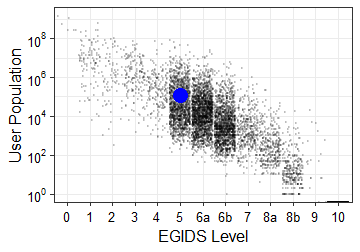 Click to enlarge with explanation