
IQU ISO 639-3
Iquitu
Akenóiri Autonym
A language of Peru
- ISO 639
- iqu
- Alternate Names
- Amacacore, Hamacore, Ikito, Ikitu, Iquita, Iquito, Puca-Uma, Quiturran
- Autonym
- Akenóiri
- Population
- 25 (Beier et al 2011), decreasing. 1 monolinguals. Ethnic population: 520 (2007 census).
- Location:
- Loreto region: Atalaya and San Antonio on Chambira, Nanay, and Pintoyacu rivers.
- Language Status
- 8b (Nearly extinct).
- Classification
- Zaparoan, Iquito-Cahuarano
- Dialects
- Pintuyacu. Cahuarano [cah] may be a dialect.
- Typology
- SVO; agglutinative language; verbal morphology exclusively suffixal; verbs are marked for tense and aspect; 11 consonants and 8 vowels (4 short, 4 long).
- Language Use
- Elderly only. Negative attitudes. Shifted to Spanish [spa].
- Language Development
- Literacy rate in L2: 75%. Grammar. Texts. Bible portions: 1963–2002. Moribund, but revitalization efforts in progress (2015 L. Michael).
- Language Resources
- OLAC resources in and about Iquitu
- Writing
- Latin script [Latn].
- Other Comments
- In 1958–1966 there were 100 speakers on the verge of extinction and acculturation to Spanish-speaking society. Children understood but did not speak, adults were bilingual with Spanish, older people understood Spanish, but only spoke Iquito. Speakers died from measles, whooping cough, and pneumonia. The rubber boom and landowner (patron) system had devastating effects. Christian.
Also Spoken in
Map
Location: Loreto region: Atalaya and San Antonio on Chambira, Nanay, and Pintoyacu rivers.
Size and Vitality
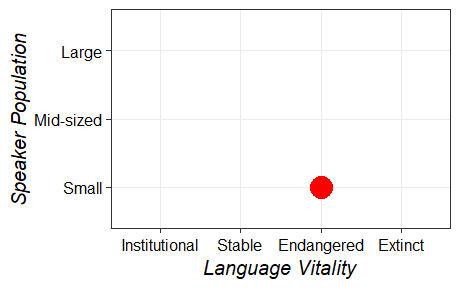 Click to enlarge with explanation
Place in Language Cloud
 Click to enlarge with explanation