
IKS ISO 639-3
Inuit Sign Language
A language of Canada
- ISO 639
- iks
- Alternate Names
- ISL, IUR, Inuit Uukturausingit, Inuk Sign Language
- Population
- 20 (Schuit 2012), decreasing. Possibly as many as 50 deaf in 2000 (MacDougall 2000). At least 20 deaf in 2012, with an unknown number of hearing with varying proficiency, but estimated to be at least twice the number of deaf (Schuit 2012). In some communities, as many as 75% of the hearing population may have known the sign language (MacDougall 2000). Ethnic population: 150 (MacDougall 2000).
- Location:
- Nunavut territory: Scattered, especially Baker Lake areas, Rankin Inlet, and Taloyoak.
- Language Status
- 8a (Moribund).
- Classification
- Sign language, Shared sign language
- Language Use
- Older adults only. Shifted to American Sign Language [ase] (Schuit 2012). Some also use English [eng] (Schuit 2012). Some also use Inuinnaqtun [ikt] (Schuit et al 2011).
- Language Development
- Grammar.
- Other Comments
- Possibly developed out of an indigenous sign language reported among the Inuit in the 18th century. Use in other parts of the Arctic where Inuit people live is not yet determined (Schuit et al 2011). Contact between deaf people diminished after Inuit people abandoned nomadic life for settled communities; this, plus education in American Sign Language (ASL) [ase] since about 1970, led to decline in IUR use. The only deaf people who use it as L1 are elderly with little or no formal schooling (Schuit et al 2011). Used now by hearing people only for communication with deaf, but previously used between speakers of different dialects (Schuit 2012).
Also Spoken in
Map
Location: Nunavut territory: Scattered, especially Baker Lake areas, Rankin Inlet, and Taloyoak.
Size and Vitality
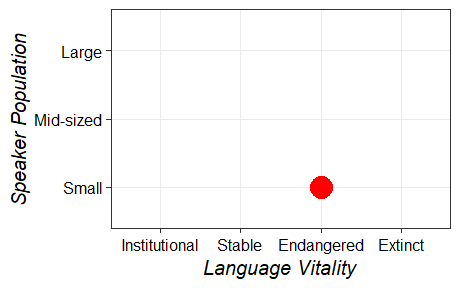 Click to enlarge with explanation
Place in Language Cloud
 Click to enlarge with explanation