
HUQ ISO 639-3
Tsat
A language of China
- ISO 639
- huq
- Alternate Names
- Hainan Cham, Hui, Huihui, Poi Tsat, Sanya Hui, Utsat, Utset
- Population
- 4,000 (Bradley 2007a). Ethnic population: 5,000 (2000 D. Bradley).
- Location:
- Hainan province: Tianya district, Sanya city, Huixin and Huihui.
- Language Status
- 6b (Threatened). Language of recognized nationality: Hui.
- Classification
- Austronesian, Malayo-Polynesian, Malayo-Chamic, Chamic, Highlands, Chru-Northern, Northern Cham
- Dialects
- None known. Reportedly most similar to Northern Roglai [rog], but very different. Tsat is structurally changed to be like Chinese.
- Typology
- SVO; prepositions; noun head initial; classifiers; dual number; no articles; monosyllabic, isolating language; aspect; 19 consonants, 7 vowels, 9 diphthongs and 3 triphthongs; tonal (5 tones: 2 level, 3 contour).
- Language Use
- Vigorous. All domains. Some young people, all adults. Positive attitudes. Most also use Mandarin Chinese [cmn], particularly the Southwest Mandarin Chinese dialect, for school (Thurgood et al 2014). Most also use Min Nan Chinese [nan], particularly the Hainanese dialect, for school (Thurgood et al 2014). Some also use Hlai [lic] (Thurgood et al 2014).
- Language Development
- Grammar.
- Language Resources
- OLAC resources in and about Tsat
- Writing
- Unwritten [Qaax].
- Other Comments
- The phonology suggests a history of some independence from other Chamic languages (Maddieson 1991). Their name for themselves is Utsat, for their language Tsat. Huihui or Hui is the Chinese name. Muslim.
Also Spoken in
Map
Location: Hainan province: Tianya district, Sanya city, Huixin and Huihui.
Size and Vitality
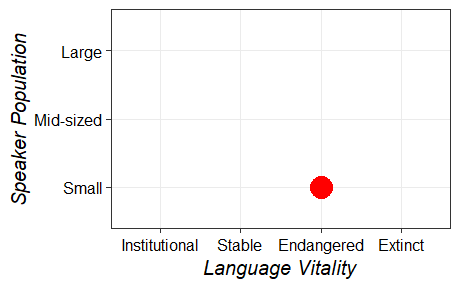 Click to enlarge with explanation
Place in Language Cloud
 Click to enlarge with explanation