
HPS ISO 639-3
Hawaii Sign Language
A language of United States
- ISO 639
- hps
- Alternate Names
- HPS, HSL, Hawai’i Pidgin Sign Language, Hawaiian Sign Language
- Population
- 40 (2019 J. Woodward), all users. Most or all of these use the mixed variety Creolized Hawaii Sign Language (CHSL). L1 users: 1 (2020 J. Woodward). There is some disagreement as to whether anyone who is still alive knows the original, pre-ASL version.
- Location:
- Hawaii, scattered.
- Language Status
- 8b (Nearly extinct).
- Classification
- Sign language, Deaf community sign language
- Dialects
- Creolized Hawaii Sign Language (CHSL, Creole Hawai’i Sign Language, Creolized Hawai’i Sign Language). The original HSL, based on data from one consultant still living who learned it as a child, and from signs remembered by users of Creolized HSL, was not related to American Sign Language (ASL) [ase] or any other known sign language, with less than 20% probable cognates with ASL (2013 J. Woodward). Currently, elderly Deaf use a mixture of HSL with ASL, a variety that linguists call Creolized Hawaii Sign Language (Clark et al 2016, 2019 J. Woodward), although most users just call it Hawaii Sign Language. There is considerable variation among users and use of HSL vocabulary is declining overall (2020 B. Earth).
- Language Use
- Some people remember and use HSL signs mixed with ASL, and some people are beginning to use the older signs more (Earth 2020). Original HSL is almost extinct, and CHSL is dying out. Most elderly Deaf use CHSL and may not recognize how much ASL vocabulary has been incorporated in their signing (2020 J. Woodward). Shifted to American Sign Language [ase]. Many also use English [eng].
- Language Development
- Texts.
- Other Comments
- Developed in the latter half of the 1800s, based on indigenous signs known to have existed as early as 1821, and probably mixed with signs brought by Deaf family members of immigrant workers, plus some influence from early Hawaii Pidgin [hwc] and newly-invented signs. HSL was used in the Deaf community (and outside class at an oralist school founded in 1914 in Palama, which moved to Waikiki in 1919). In 1939, ASL was introduced to the islands by a Catholic priest, John McCummiskey, a new school principal, Sam D. Palmer (CODA) and other Deaf from the mainland. Although there was initial resistance to ASL signs, students who attended school after that acquired a mixture of HSL and ASL. By the end of the 1950s, the school used ASL almost completely, and almost everyone in the Deaf community had shifted to ASL or mixed HSL/ASL. (Earth 2020) It is unclear how many people are still alive who learned HSL prior to ASL influence. Currently, the mixed variety, CHSL, is often just called HSL. The name ‘Hawai’i Pidgin Sign Language’ is no longer commonly used, as original HSL was not itself a pidgin and had only an indirect relationship to Hawaii Pidgin [hwc].
Also Spoken in
Map
Location: Hawaii, scattered.
Size and Vitality
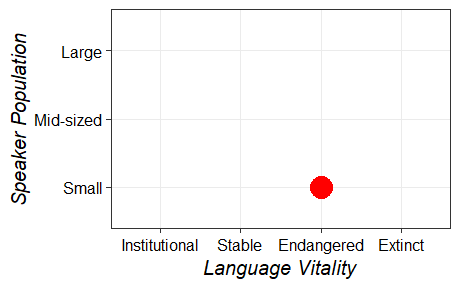 Click to enlarge with explanation
Place in Language Cloud
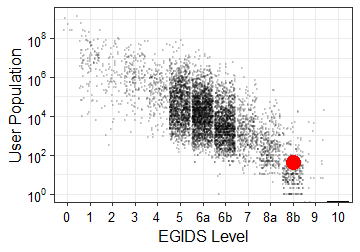 Click to enlarge with explanation