
HAU ISO 639-3
Hausa
Hausa Autonym
A language of Nigeria
- ISO 639
- hau
- Alternate Names
- Abakwariga, Habe, Haoussa, Hausawa, Kado, Mgbakpa
- Autonym
- Hausa
- Population
- 55,800,000 in Nigeria, all users. L1 users: 37,900,000 in Nigeria (2020). L2 users: 17,900,000 (2018). Total users in all countries: 77,063,700 (as L1: 50,770,700; as L2: 26,293,000).
- Location:
- Widespread.
- Language Status
- 2 (Provincial). De facto provincial language in northern region. Spoken as L2 in the north.
- Classification
- Afro-Asiatic, Chadic, West, A, A.1
- Dialects
- Kano, Katagum, Hadejiya, Sokoto, Gobirawa, Adarawa, Kebbawa, Zamfarawa, Katsina, Arewa. Barikanchi [bxo] is a Hausa pidgin used in military barracks. There is also a pidgin or market Hausa [gib]. Subdialects of Eastern Hausa: Kano, Katagum, Hadejiya; of Western Hausa: Sokoto, Katsina, Gobirawa, Adarawa, Kebbawa, Zamfarawa; of North Hausa: Arewa, Arawa. Abakwariga is a subgroup.
- Typology
- SVO; prepositions; noun head final, but numbers follow noun; gender (masculine/feminine); 33 consonants, 10 vowels, 2 diphthongs; tonal (2 tones: high, low).
- Language Use
- Used as L2 by Abishi [pcn], Adara [kad], Ahwai [nfd], Ajawa [ajw], Ajiya [idc], Alago [ala], Aninka [aqk], Awak [awo], Ayu [ayu], Bacama [bcy], Bade [bde], Bali [bcn], Bankal [jjr], Basa-Gumna [bsl], Bassa-Kontagora [bsr], Bata [bta], Belning [glb], Bena [yun], Berom [bom], Bijim [jbm], Bille [bil], Bina [byj], Bisã [bqp], Boko [bqc], Bokobaru [bus], Bo-Rukul [mae], Bu [jid], Bu [zbu], Bure [bvh], Cahungwarya [nat], Cakfem-Mushere [cky], Cara [cfd], Cicipu [awc], Cineni [cie], Cishingini [asg], C’Lela [dri], Dadiya [dbd], Dass [dot], Deno [dbb], Dera [kna], Duguri [dbm], Dulbu [dbo], Duya [ldb], Dza [jen], Eastern Acipa [acp], Ebira [igb], Eggon [ego], Eloyi [afo], Etkywan [ich], Fali [fli], Firan [fir], Ga’anda [gqa], Gamo-Ningi [bte], Gengle [geg], Gera [gew], Geruma [gea], Giiwo [kks], Goemai [ank], Gude [gde], Gurmana [gvm], Guruntum-Mbaaru [grd], Gwa [gwb], Gwak [jgk], Gwamhi-Wuri [bga], Gwandara [gwn], Gyaazi [gyz], Gyem [gye], Hasha [ybj], Hausa Sign Language [hsl], Hõne [juh], Hwana [hwo], Izora [cbo], Jakattoe [jrt], Jara [jaf], Jibu [jib], Jimi [jmi], Kaan [ldl], Kadung [dkg], Kam [kdx], Kamuku [cdr], Kibaku [ckl], Koenoem [kcs], Koma [kmy], Koro Nulu [vkn], Koro Wachi [bqv], Koro Zuba [vkz], Kpasham [pbn], Kubi [kof], Kudu-Camo [kov], Kugama [kow], Kulung [bbu], Kumba [ksm], Kusur-Myet [tdl], Kutep [kub], Kyanga [tye], Kyoli [cry], Labir [jku], Lala-Roba [lla], Lere [gnh], Longuda [lnu], Lopa [lop], Luri [ldd], Mama [mma], Mangas [zns], Mbat [bau], Mboi [moi], Mbula-Bwazza [mbu], Miya [mkf], Ndoola [ndr], Ngizim [ngi], Ngwaba [ngw], Nikyob-Nindem [kdp], Ninzo [nin], Nteng [nqt], Numana [nbr], Nungu [rin], Nya Huba [hbb], Nyankpa [yes], Nyong [muo], Pa’a [pqa], Pangu [png], Pero [pip], Piapung [pcw], Piya-Kwonci [piy], Polci [plj], Pyam [pym], Pye [pai], Reshe [res], Rom [tdk], Ron [cla], Samba Daka [ccg], Shama-Sambuga [sqa], Shanga [sho], Sheni [scv], Shiki [gua], Shoo-Minda-Nye [bcv], Siri [sir], Sorko [bze], Sukur [syk], Tal [tal], Tangale [tan], Teme [tdo], Tera [ttr], Tigon Mbembe [nza], Tiyaa [tyy], Tsikimba [kdl], Tsishingini [tsw], Tsucuba [cbq], Tsuvadi [tvd], Tugbiri-Niragu [grh], Tunzuii [dza], Tyap [kcg], ut-Ma’in [gel], Wandala [mfi], Warji [wji], Yangkam [bsx], Yendang [ynq], Yukuben [ybl], Zari [zaz], Zeem [zua], Zhire [zhi].
- Language Development
- Literature. Radio. TV. Dictionary. Grammar. Bible: 1932–2015.
- Language Resources
- OLAC resources in and about Hausa
- Writing
- Arabic script, Naskh variant [Arab]. Braille script [Brai]. Latin script [Latn], used since 1880, primary usage.
- Other Comments
- Muslim, Christian, traditional religion.
Also Spoken in
- Location
- Scattered. Est region: Gourma and Tapoa provinces.
- Language Status
- 5 (Dispersed)
- Other Comments
- Non-indigenous. Muslim. View other languages of Burkina Faso
Language Name
Hausa
User Population
3,000 in Burkina Faso (2021 Joshua Project).
- Location
- Widespread north: Alibori, Atacora, Borgou, and Donga departments, mainly in larger towns, market villages.
- Language Status
- 3 (Wider communication)
- Other Comments
- Non-indigenous. Muslim, Christian, traditional religion. View other languages of Benin
Language Name
Hausa
User Population
1,056,000 in Benin (2019 Joshua Project), L2 users.
- Language Status
- Unestablished
- Other Comments
- Non-indigenous. View other languages of Central African Republic
Language Name
Hausa
User Population
34,000 in Central African Republic (2021 Joshua Project).
- Language Status
- Unestablished
- Other Comments
- Non-indigenous. View other languages of Congo
Language Name
Hausa
User Population
10,700 in Congo (2018).
- Location
- Abidjan.
- Language Status
- 5 (Dispersed)
- Other Comments
- Non-indigenous. View other languages of Côte d’Ivoire
Language Name
Hausa
User Population
395,000 in Côte d’Ivoire (Leclerc 2017c). Ethnic population: 1,000,000.
- Location
- Widespread.
- Language Status
- 5 (Dispersed)
- Other Comments
- Non-indigenous. Muslim. View other languages of Cameroon
Language Name
Hausa
User Population
312,500 in Cameroon, all users. L1 users: 23,500 in Cameroon (1982 SIL). L2 users: 289,000 (2018 J. Leclerc).
- Language Status
- Unestablished
- Other Comments
- Non-indigenous. View other languages of Algeria
Language Name
Hausa
User Population
11,600 in Algeria (2020).
- Language Status
- Unestablished
- Other Comments
- Non-indigenous. View other languages of Gabon
Language Name
Hausa
User Population
16,000 in Gabon (2021 Joshua Project). , based on ethnicity.
- Location
- Widespread.
- Dialects
- None known. There is evidence to suggest Ghanaian Hausa is a distinct variety of Hausa.
- Language Status
- 3 (Wider communication)
- Other Comments
- Non-indigenous. Muslim. View other languages of Ghana
Language Name
Hausa
User Population
565,000 in Ghana, all users. L1 users: 275,000 in Ghana (2017 J. Leclerc). L2 users: 290,000 (2019 Joshua Project).
- Location
- Widespread.
- Dialects
- Dawra, Katsina, Damagaram, Gobirawa, Aderawa, Arewa, Kurfey, Gaya.
- Language Status
- 3 (Wider communication)
- Other Comments
- Muslim. View other languages of Niger
Language Name
Hausa
User Population
17,700,000 in Niger, all users. L1 users: 11,900,000 in Niger (2019). L2 users: 5,800,000 (2019).
- Location
- Blue Nile and Khartoum states; scattered in Khartoum, along Blue Nile river; Kordofan.
- Language Status
- 5 (Dispersed)
- Other Comments
- Non-indigenous. View other languages of Sudan
Language Name
Hausa
User Population
740,000 in Sudan, all users. L1 users: 80,000 in Sudan (2007). L2 users: 660,000 (2017).
- Location
- Widespread in the south.
- Language Status
- 3 (Wider communication)
- Other Comments
- Non-indigenous. View other languages of Chad
Language Name
Hausa
User Population
398,000 in Chad, all users. L1 users: 100,000 in Chad (Gunnemark and Kenrick 1985). L2 users: 298,000 (2019 Joshua Project).
- Location
- Widespread, especially north; mostly larger towns; Lome.
- Language Status
- Unestablished
- Other Comments
- Non-indigenous. Muslim. View other languages of Togo
Language Name
Hausa
User Population
21,900 in Togo (2019).
Map
Location: Widespread.
Size and Vitality
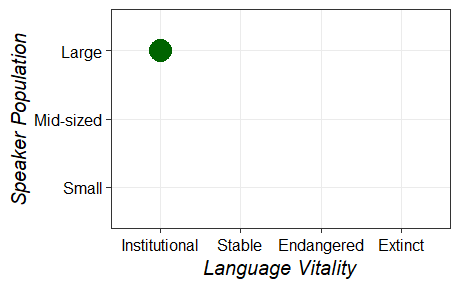 Click to enlarge with explanation
Place in Language Cloud
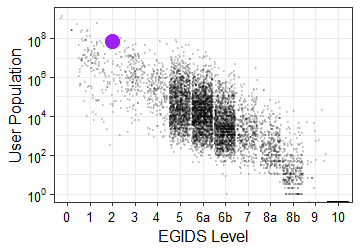 Click to enlarge with explanation